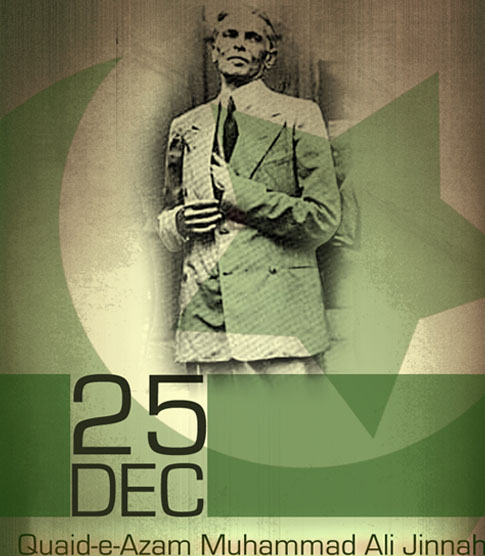
With all the buzz about Jaswant Singh’s book, our regular contributor, Asiha Fayyazi Sarwari, has shared the transcript of a radio show she did some time back.
In 2001 I had the opportunity to Interview Sir Christopher Lee for a radio show I produced for Pakistan News Service in California., Aisha
Aisha Sarwari: Sir Christopher Lee, we are honored to have you here on the show (Previously Pakistan News Service), thank you for your time.
Sir Christopher Lee: Not at all
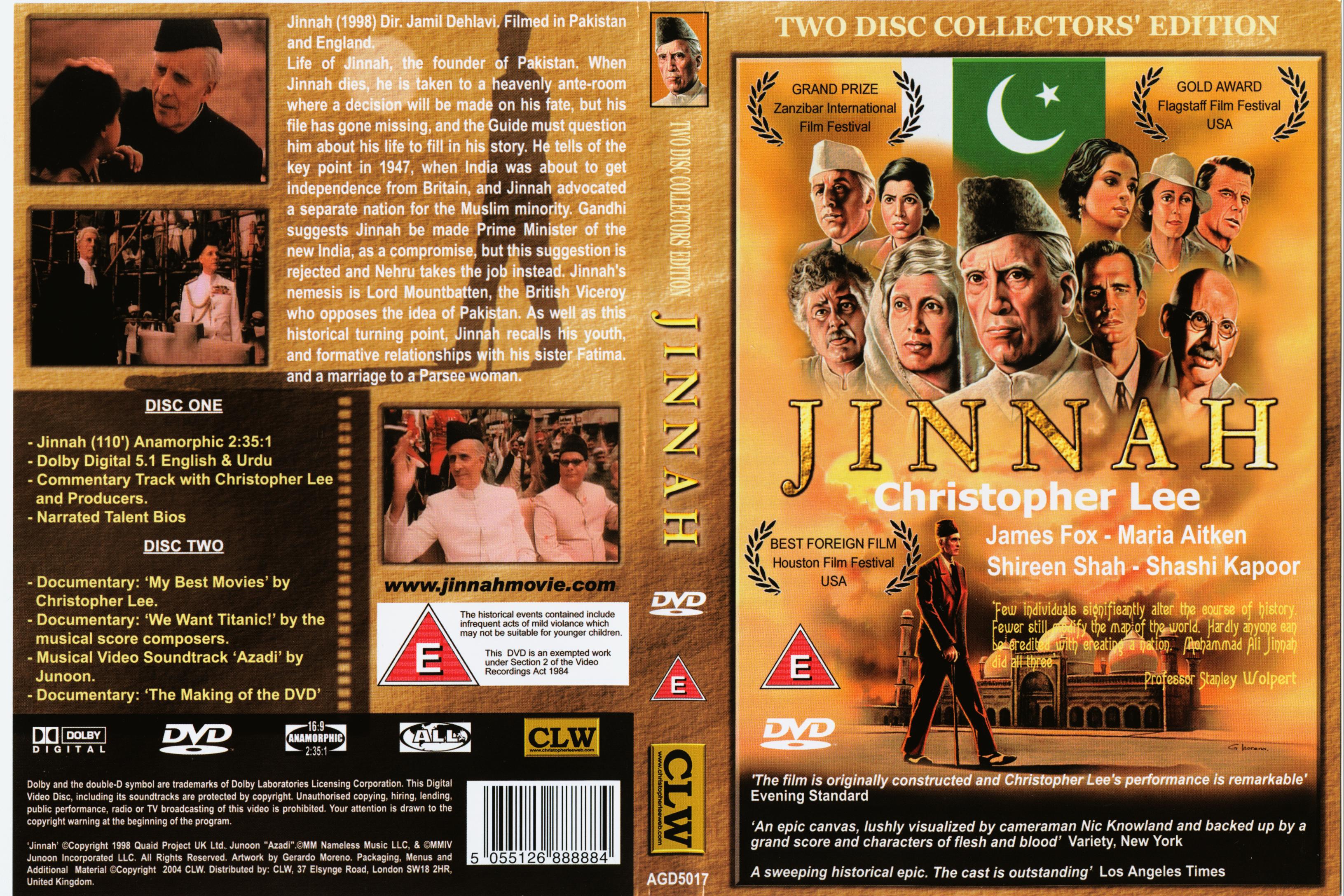
Aisha Sarwari: I’d like to ask you a few questions about the recently released film, Jinnah of Pakistan, Produced by Jamil Dehlvi and directed by Akbar S. Ahmed. I am curious to know how an independent film like this inspire you to act as a lead, in comparison to box office hits like, say, The Lord of The Rings?
Sir Christopher Lee: You can’t compare one film with another. Because you have to remember that Jinnah was a comparatively low budget picture, although it looks like a very big budget picture. You can’t possibly compare a film which is about basically one individual and the people around him who created a nation with a film like The Lord of The Rings which is a great epic, in fact, it is three films. And it’s not just about basically one person, certainly not about one person who was a founder of a modern nation.
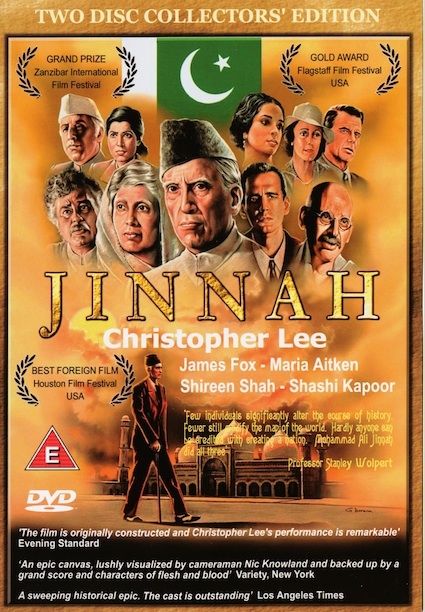 Aisha Sarwari: What is your perception about Mohammad Ali Jinnah now, after the film, did it change significantly or did you know about him before you chose the movie?
Sir Christopher Lee: I think that the film Jinnah, is an extremely important film for many reasons and it should be seen now. The reasons, and there are quite a few of them: One, it shows the true meaning of Islam, Islam means submission to the will of God, it does not mean terrorism, fundamentalism. Secondly it shows the creation of a Muslim state and how it came into being. How the founder of that nation achieved this and again, it has nothing to do with all the dreadful things that are happening recently.
It is a story of a true Muslim and the people around him who decided that the Muslims of India need a country of their own. They say there are still sever million Muslims still living in India but of course Pakistan was created in 1947, recorded partition between Indian and what they call Pakistan. The man responsible for this, it was one man, Muhammad Ali Jinnah: known of course to Pakistan as the Quaid-e-Azam which means “The Great Leader.”
A brilliant man with great intellect, great determination and an iron will, honest, a man of total integrity and he believed implicitly in what he was doing and he was determined that it would be for the good of the Muslim population to have their own country. So the story is not just about the creation of a state which is of course with us today, it’s about basically one man and what he achieved, not just as a political leader but as a father, as a brother and a husband.
Now, a lot of this information is largely unknown to the vast majority of the people today and many hundreds of millions of Muslims around the world. He did single handedly, almost single handedly, not entirely single handedly, because obviously he had very fine advisers and determined dedicated people around him. He almost single handedly did create this nation.
And he was a dying man and he knew it. And this is quite clear in the film because he has a meeting with a doctor. He died of cancer of the lungs. He was a chain smoker and many of the photographs you see of him, he will have a cigarette or a pipe or a cigar in his hands, unless of course he was at an official function and he was making a speech. There is probably no doubt about that, that it probably hastened his death.
But he knew it, he knew he was dying which is even more remarkable that he was able to keep going. So, it is a story in a sense of the creation of a nation.
For me as an actor, it is certainly the most important role I have ever played, because of the responsibility on my shoulders was immense. I went to the country he founded. I was there for ten weeks playing the leader of the nation, the creator of the nation in the country he created in front of his own people.
And I can only say that with the exception of one newspaper which attacked us virtually everyday, we received the gratitude of virtually everybody I spoke to: members of his family, people who knew him, who worked for him and with him, some of them still alive today, considerably older than I am, most of them, but, the man on the street, wherever I went whether it was a member of the armed forces, whether it was a policeman, whether it was a somebody who owned a shop, whether it was a newspaper man, whether it was people working in the hotels, it didn’t matter, they all said the same thing to me: Thank You “ Thank you so much for coming to our country and making for the first time a film about our great leader, we are profoundly grateful.
The film has been shown in Pakistan for something like three months, both in English and in Urdu, which incidentally Jinnah did not speak very well and it was very successful.
It has also been shown at various festivals around the world. It has had the most wonderful reviews wherever it has been seen. In the western world as well as the eastern world, at the London Film Festival and the festival in New York, the reviews in the Los Angeles Times and a few of the other newspapers and the reviews here, were the best that I have ever had in my life as an actor. So of course that is immensely important to me, as an actor.
Aisha Sarwari: How did you recreate him in your acting?
Sir Christopher Lee: I tried to create a true picture, I certainly did resemble him, physically, I tried by looking at old newsreels to recreate the way he walked, the way he gestured, the way he spoke and his voice. The extraordinary thing was that he had absolutely no accent; he spoke English like I do, which is accordingly the way I spoke in the film.
One of the interesting things I was told was that he used to make speeches to something like a hundred thousand people, and his command over Urdu was not all that good, and he used to make speeches in English, to a hundred thousand people, practically none of whom understood at all, but it didn’t seem to make the slightest bit of difference.
When you talk about the word, charisma, which is often a word overused, but this is one man who had an amazing and extraordinary charisma, personality, presence, power and in spite of the fact that they may not have understood what he was saying, they did seem to know what he was talking about, so it’s a film of which we are all extremely proud, it should be seen, it deserves to be seen, and as I have explained at some length, for me as an actor, it is the greatest responsibility I have ever had and the best part I have ever had as an actor and probably so far as I am any judge the best performance I have ever given.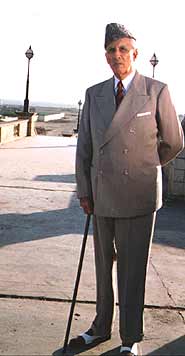
Aisha Sarwari: Can you tell us about how the props helped in the creation of Jinnah’s character, the fact that you had a cigar in some of the scenes, how did those affect your performance?
Sir Christopher Lee: Now there are actual photographs of Jinnah playing billiards or pool, or whatever it was they were playing, presumably English billiards. Actual photographs of him at the billiard table about to strike the ball with his cue, and he is smoking a cigar or he has a cigar in his hands. So that is why I did smoke, occasionally a cigarette at the breakfast scene with my daughter as she comes to tell me that she is going to marry a Parsi. I disapprove strongly, which is rather ironic in the view of the fact that Jinnah himself married a Parsi.
But, any scene that you see in which I am smoking is historically accurate.
Aisha Sarwari: As you mentioned, Pakistanis have tremendous reverence for Muhammad Ali Jinnah, or the Quaid-e-Azam-
Sir Christopher Lee: Oh yes. Absolutely.
Aisha Sarwari: How was your reaction generally to, you said it was a challenge, but what did you really feel when people came up to you and thanked you for giving his life such contemporary star power?
Sir Christopher Lee: I felt that it was a great honor. I felt a great sense of humility. As a western Christian playing an Asian Muslim, it would have been perfectly understandable for people to have objected, and some did. There was one particular individual insisted that I was deported, but that was thrown out of the courts.
That is why I say it was such a great responsibility. When people came up to me an expressed their gratitude and 99.9% did, it gave me a wonderful feeling of satisfaction, and it was a great privilege and a great honor to say this to me, because they meant every word of it, otherwise they wouldn’t have bothered.
Aisha Sarwari: What made you choose the film? What made you sign up for it?
Sir Christopher Lee: Of course, because of the age that I am now. I am 80 years old, I was well aware of Jinnah, just about as well aware as I was of Gandhi, though Gandhi got much more publicity over the years. I was well aware of Jinnah as a person, as a politician as a leader. His name was by all means not a strange name. It was a name of which I was very familiar because of the newsreels and the newspapers and indeed in 1947, I was 25 years old and I had come out of five years of war in 1946.
And I had been during the war with Indian troops because everybody was Indian then before the partition many of course being Muslims and many being Hindus and many being Sikhs. So it wasn’t a strange experience for me at all. I felt perfectly comfortable in playing the part.
The Pakistani actors in the film were very kind to me and we had a very distinguished Indian actor in the firm, Shashi Kapoor, and it was a great gathering of Pakistanis, British and Indians. And that is why the results were so encouraging and that is why I can only repeat, that it is a film that should be seen.
I really don’t know exactly why people are unwilling to show it theatrically, I think this will happen eventually on PBS, it might be on Network, it might be shown in the cinemas, in the theaters and it should be shown on DVD. It has already been shown on Sky satellite in UK for over a year. So it has been getting a showing, but not an overall world wide showing it should have.
People seem to be, perhaps the word is nervous, in showing it, because there is this great misconception around the world that has certainly not been helped by the acts of terrorism, especially after September the 11th, committed by Muslims. And it is a misconception that all Muslims are the same, they are not, and it may be that the theater owners or the distributers are unwilling or slightly anxious about showing this film incase people say, how can you show a film like this when we see what is happening in the whole world, which is the result of some act by Muslims.
You cannot possibly apply the adjective terrorist, fundamentalist, who no doubt are sincere in what they do, but who cannot possibly apply this to the vast majority of people who are Muslims, because it simply isn’t correct. That is why this film should be seen to give a true picture of the meaning of Islam and also of the founding of a Muslim state which was created for the right reasons.
If you go to Pakistan, I don’t think there is a single place you could go into, any restaurant, any building and any office where there isn’t either a photograph or a picture of the Quaid-e-Azam, at least wherever I went that is the case. He is much revered in Pakistan. It’s almost a god-like figure, certainly an icon. And I think this film is very important because as I said earlier, majority of Pakistanis are not aware of what went on in his life, except that he did found the nation.
Aisha Sarwari: What do you make of the secular Jinnah, The man whose vision encompassed Muslims as well as Christians, Hindus and Sikhs in Pakistan, especially with regard to his August 11th speech where he says, “You are free to go to your mosques and temples in this state of Pakistan”
Sir Christopher Lee: I think if you see in the film, when he speaks to Pakistani leaders, in which says, and I actually did say it word for word in the film, he said, and I am not saying it word for word now because I can’t remember it all, but he did say very clearly, you are free, all of you from any religion, free to worship your various churches, mosques, synagogues. This is very important I believe because he was advocating complete freedom, not only of speech, but of worship of all religions. That again tells you how he felt not just about Muslims and Hindus and Christians and Jews or any other religion you could think of “ Freedom of Worship, Freedom of Worship. He said this again and again and again in many words.
Aisha Sarwari: He also goes on to say, “this has nothing to do with the business of the state.”
Sir Christopher Lee: In other words, that’s quite true, he was saying, the state is the state. We are a Muslim state, but you don’t have to be a Muslim to practice your own religion. You can do it anywhere with complete freedom in a Muslim state. And I am not aware of that happening anywhere before in History.
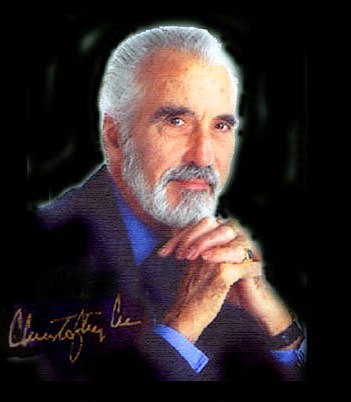 Aisha Sarwari: Tell us about your life as an actor and what is in your opinion, the role of an actor in the context of the world.
Sir Christopher Lee: Well I have been an actor for 56 years, and I have been involved in something like 250, 260 productions either as films or Television films, and so the role of an actor is to present characters and people, both imaginary and factual to an audience out there.
In this particular instance what we are telling is the truth. Of course there is this sequence of a surrealistic trial where Jinnah the barrister is in a sense the prosecuting counsel against Mountbatten. Now this is based on the truth because the witnesses coming forward are telling the truth, commander of the army who did not support him has to admit this on the witness stand; Radcliffe has to admit that the line, the boundary line, was changed on Mountabtten’s orders. And Lord Ismay also confirmed this that Mountbatten brought the date forward of Partition for personal reasons. So that trial was in a sense to establish the truth of what really happened at that time with regard to not only Jinnah, but Gandhi and Nehru and the Mountbattens.
Now, my role as an actor is to give the best performance I can give, in anything I do, to be convincing, to at times surprise the audience, to do something that they don’t necessarily expect. But basically it is to create people and that is the vocation of any actor who is a real professional and really cares about what he is doing.
Now, what was the second part of your question?
Aisha Sarwari: I asked about an actor’s role in the context of a global world.
Sir Christopher Lee: In the context of the world if you are making a contemporary story it has to be accurate. If you are presenting a Historical story, it has to be even more accurate because obviously sometimes you go back centuries and sometimes it is extremely difficult because you get differing information but we are talking about comparatively recent history now, 55 years ago and therefore in this instance it has to be completely honest and totally truthful because it is the modern era.
Aisha Sarwari: What do you make of Pakistan now, the bad press, the geopolitical issues?
Sir Christopher Lee: Well you’re not going to get me in a political conversation because I am not qualified to discuss it. At the present moment there is conflict between India and Pakistan, and has been for many many years, as I think everybody knows which is I think a great tragedy because apart from their religious differences they are essentially the same people.
Right now we have a military government in Pakistan with enormous responsibilities and with great problems and I think the president, General Pervez Musharraf is doing the best he can but it is very difficult for him. The same thing applies to the Indians. I think they are trying to solve the problem, the eternal problem, to what Jinnah referred to in this film as this mess about Kashmir.
I don’t know how this is going to be solved, I have no idea, I am not a politician, I am not a military man. I only hope it will be solved and the two countries live in peace but this is something that is a hope as far as I am concerned. A hope of many millions of people all around the world, because it is a very tense situations.
I think if the Quaid-e-Azam, Jinnah himself were to come back today, I think he would be very dismayed at what is taking place because this is something that he never envisaged, or thought would happen, although at the time of partition there was a great deal of death.
Aisha Sarwari: Sir Christoper Lee, I want to thank you for your time and as a Pakistani I thank you for portraying our leader so well.
Sir Christoper Lee: Not at all. I am glad to have the opportunity to talk to you and I am glad that you have had the opportunity to have heard how I feel and what I am saying, because one is often so misrepresented in the press. And I am able now to give you my own, I have to emphasize this, my own personal feelings. Thank you, for the opportunity for me to do so.
Question from the audience: What do History Professors say about this film? Is this not most likely a History of Pakistanis?
Sir Christoper Lee: History Professors have said that this film may not be 100% accurate but it is acceptable. You must remember that although I knew what was paramount about Jinnah and although I learned a great deal more by reading about him from books and by talking to people who knew him, you must remember that I am still presenting on screen a person from a printed page.
A script was written, alright it was written by Pakistanis because they wanted the truth to be shown, because in the film, Gandhi by Richard Attenborough, Jinnah appears briefly as an evil character who threatens civil war “ That is a complete distortion of fact and of History.
Gandhi and Jinnah both got on very well. They both liked each other and they were friends, they were both lawyers, both Gujrati. They differed politically but there was no hatred, none. And there are some lovely moments in the film when Gandhi is asked what is Jinnah going to say and he says, Ah, Jinnah will say wily old Gandhi, And indeed because Jinnah does. They understood each other very well. They came very much from the same background, not religiously but in every other way.
Jinnah they say was even an actor at one stage in his life, but I am not sure there is any proof of that, but he certainly went to the House of Parliament to listen to people speaking, and he certainly practiced law successfully. He was very well acquainted with the English language and he was fluent in it, and if you listen to the tapes, there is no accent, not at all.
Gandhi of course did have an accent and a very strong one too. And I think the man who plays Gandhi in this film, Jinnah is absolutely brilliant, and I think he is, how do I say this with all respect, better than Ben Kingsley was.
I think everybody in this film gives extraordinary performance.
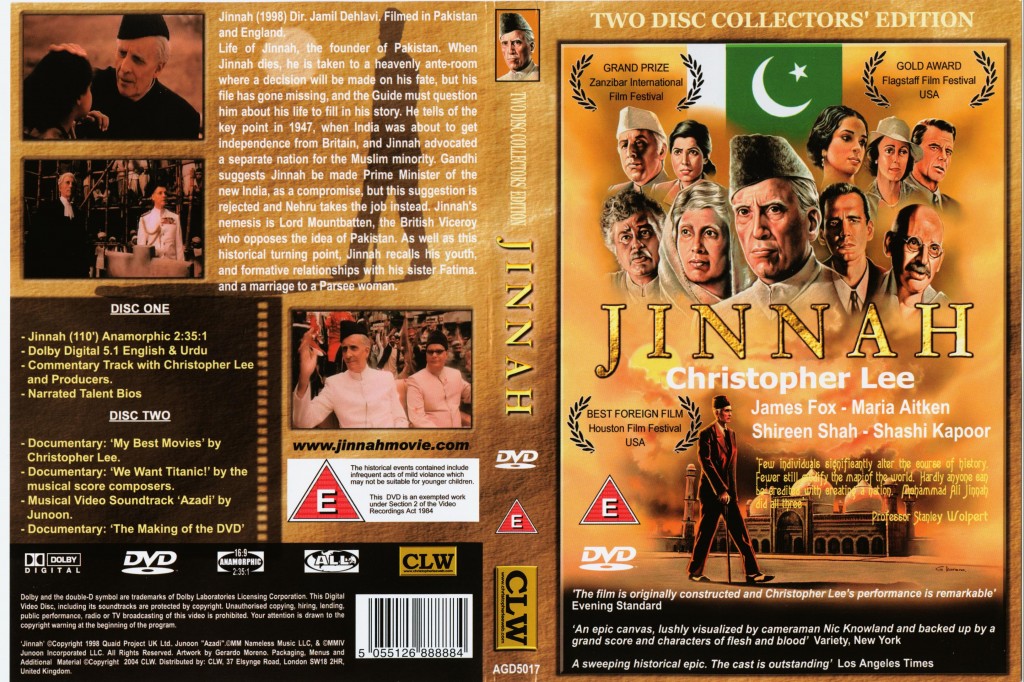
— ————————————————————————-End Of Interview——————————————————————-
It is said that a good actor always get into its character and that what Sir Christopher Lee say about Quaid-e-Azam’s character :
Christopher Lee on Founder and Father of Pakistan ( Quaid-e-Azam )