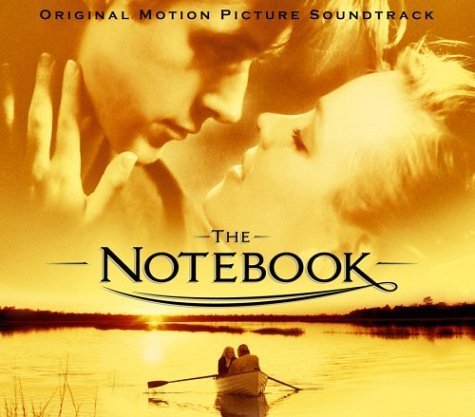
The Notebook ( the movie )

March 15th, 2012, posted in MOViES
Share

The Notebook moive

This is one of my favorite movie. I watched it many years back but didn’t knew the name of the movie. Just couple of days back I got chance to this movie again and this time I got chance to the name of it as well. So, I thought why don’t read about it and write what others have written about it.

“The Notebook” is the story of a boy from the poor side of the tracks who – predictably – falls for a beautiful, rich girl. What is not so predictable is how far he’ll go to prove they were meant to be together.

Rachel McAdams stars as sheltered Southern Belle, Allie Hamilton. Allie pays a visit to Seabrook, North Carolina to see her family and while there, Noah Calhoun  works his ‘small-town boy’ charms on her. Despite disparate backgrounds, the two find they’ve got a lot in common, including a zest for life – and their need to drive each other crazy. Over the span of a hot North Carolina summer, Allie and Noah fall passionately in love.
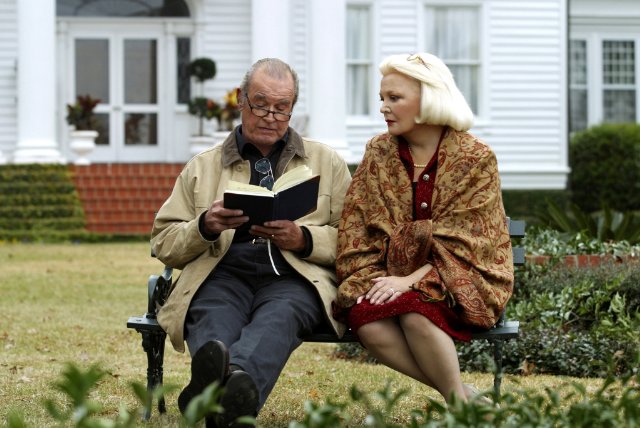
notebook old age

But all doesn’t go smoothly for the mismatched pair of lovebirds. Allie’s mom puts the kibosh on their relationship, sending Allie off to school and out of Noah’s reach. Still Noah persists until finally, seven long years later, Allie returns to Seabrook and must choose between her rich, handsome fiancée (James Marsden) and her first love, the equally handsome but not-so-wealthy, Noah.

Noah’s character is so much more romantic in the movie than in the book. Do not get me wrong, Noah always loves Allie, but writing one love letter a day for a year before giving up is much more intense than writing a letter once a month for seven years. In the book it feels like Noah regards Allie as an old pen pal, but in the movie it seems as if he cannot live without her. It is also very dramatic because Noah sends off his very last love letter right before leaving for war, whereas in the movie Noah sent his last love letter in 1939 and did not enlist in the war until 1941! The timeline has been shortened for the movie, which makes it easier for younger audiences to relate too.

notebook kissOn the other hand I love the spirituality of the book and how Noah regards Allie, which is an element that is somewhat missing in the movie. Yes Allie and Noah had a red hot reunion, but the focus of the movie seems to be more about the physicality than their spiritual connection. In the book Noah kept the painting Allie made for him fourteen years earlier and admires it on his wall, whereas her fiance was not very excited about a similar piece she painted for him. Thus, we can see the deeper connection between Allie and Noah in the book than in the movie. Although in the movie Noah gives Allie a set of paints because he knows she feels most free when she is painting, but even that scene does not go as deep as the book. I love the description in the book of how Noah puts up with Allie getting paint on furniture and around the house during their marriage, which shows the pet peeves couples have to put up with in life long relationships. Thus, both the book and the movie have their strong points, but you will never know unless you read the book and/or watch the movie.

The filmmakers got it right when they chose Gosling, McAdams, Marsden, James Garner and Gena Rowlands. Each of these actors is pitch-perfect. Each brings a freshness to these characters. Even though we’ve seen the same types of characters before, these actors makes them feel interesting and unique.the notebook movie quote
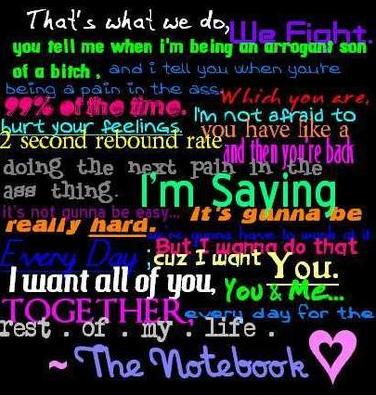
“The Notebook” is a gentle romantic tale in the midst of blockbuster action films and goofball comedies. It could be argued that releasing it in mid-June is counter-programming at its best, giving adults who don’t want their senses assailed by CGI special effects a real choice at the box office. But you have to wonder if “The Notebook” would have stood a better chance of finding the right audience had it been released later in the year, when moviegoers are really ready for more intense storytelling, than during the crowded summer months.

For a movie that might have plunged full-scale into bathos, ”The Notebook” tries to remain restrained. The camera caresses the lush Southern landscape of blood-red sunsets and flocks of ducks, and Aaron Zigman’s romantic score drizzles only a light coating of syrup over the ice cream.
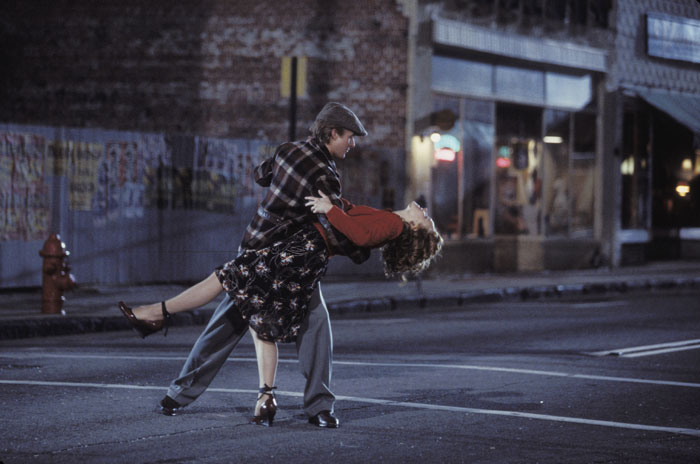
Notebook dance

“The Notebook” isn’t just a film for women. It’s a movie for anyone who wants to get lost in a beautiful story, for anyone who believes romance is still alive on film.

Note : It is rated PG-18 for some sexuality.
Share

Now I Know How Shazam Works

March 14th, 2012, posted in MOBiLE
Share
There is a cool service called Shazam, which take a short sample of music, and identifies the song.  There are couple ways to use it, but one of the more convenient is to install their free app onto an iPhone.  Just hit the “tag now” button, hold the phone’s mic up to a speaker, and it will usually identify the song and provide artist information, as well as a link to purchase the album.

What is so remarkable about the service, is that it works on very obscure songs and will do so even with extraneous background noise.  I’ve gotten it to work sitting down in a crowded coffee shop and pizzeria.
So I was curious how it worked, and luckily there is a paper written by one of the developers explaining just that.  Of course they leave out some of the details, but the basic idea is exactly what you would expect:  it relies on fingerprinting music based on the spectrogram.
Here are the basic steps:
1. Beforehand, Shazam fingerprints a comprehensive catalog of music, and stores the fingerprints in a database.
2. A user “tags” a song they hear, which fingerprints a 10 second sample of audio.
3. The Shazam app uploads the fingerprint to Shazam’s service, which runs a search for a matching fingerprint in their database.
4. If a match is found, the song info is returned to the user, otherwise an error is returned.
Here’s how the fingerprinting works:
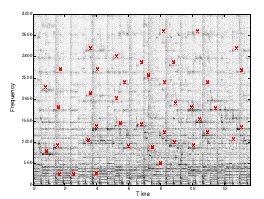
You can think of any piece of music as a time-frequency graph called a spectrogram.  On one axis is time, on another is frequency, and on the 3rd is intensity.  Each point on the graph represents the intensity of a given frequency at a specific point in time. Assuming time is on the x-axis and frequency is on the y-axis, a horizontal line would represent a continuous pure tone and a vertical line would represent an instantaneous burst of white noise.  Here’s one example of how a song might look:

There is a cool service called Shazam, which take a short sample of music, and identifies the song.  There are couple ways to use it, but one of the more convenient is to install their free app onto an iPhone.  Just hit the “tag now” button, hold the phone’s mic up to a speaker, and it will usually identify the song and provide artist information, as well as a link to purchase the album.
What is so remarkable about the service, is that it works on very obscure songs and will do so even with extraneous background noise.  I’ve gotten it to work sitting down in a crowded coffee shop and pizzeria.
So I was curious how it worked, and luckily there is a paper written by one of the developers explaining just that.  Of course they leave out some of the details, but the basic idea is exactly what you would expect:  it relies on fingerprinting music based on the spectrogram.
Here are the basic steps:
1. Beforehand, Shazam fingerprints a comprehensive catalog of music, and stores the fingerprints in a database.2. A user “tags” a song they hear, which fingerprints a 10 second sample of audio.3. The Shazam app uploads the fingerprint to Shazam’s service, which runs a search for a matching fingerprint in their database.4. If a match is found, the song info is returned to the user, otherwise an error is returned.

Here’s how the fingerprinting works:
You can think of any piece of music as a time-frequency graph called a spectrogram.  On one axis is time, on another is frequency, and on the 3rd is intensity.  Each point on the graph represents the intensity of a given frequency at a specific point in time. Assuming time is on the x-axis and frequency is on the y-axis, a horizontal line would represent a continuous pure tone and a vertical line would represent an instantaneous burst of white noise.  Here’s one example of how a song might look:

shazam-spectrogram

Spectrogram of a song sample with peak intensities marked in red. Wang, Avery Li-Chun. An Industrial-Strength Audio Search Algorithm. Shazam Entertainment, 2003.Â

The Shazam algorithm fingerprints a song by generating this 3d graph, and identifying frequencies of “peak intensity.”  For each of these peak points it keeps track of the frequency and the amount of time from the beginning of the track.  Based on the paper’s examples, I’m guessing they find about 3 of these points per second. [Update: A commenter below notes that in his own implementation he needed more like 30 points/sec.]  So an example of a fingerprint  for a 10 seconds sample might be :


Frequency in Hz Time in seconds
823.44 1.054
1892.31 1.321
712.84 1.703
. . . . . .
819.71 9.943

Shazam builds their fingerprint catalog out as a hash table, where the key is the frequency.  When Shazam receives a fingerprint like the one above, it uses the first key (in this case 823.44), and it searches for all matching songs.  Their hash table might look like the following:


Frequency in Hz Time in seconds, song information
823.43 53.352, “Song A” by Artist 1
823.44 34.678, “Song B” by Artist 2
823.45 108.65, “Song C’ by Artist 3
. . . . . .
1892.31 34.945, “Song B” by Artist 2

[Some extra detail: They do not just mark a single point in the spectrogram, rather they mark a pair of points: the “peak intensity” plus a second “anchor point”.  So their key is not just a single frequency, it is a hash of the frequencies of both points.  This leads to less hash collisions which in turn speeds up catalog searching by several orders of magnitude by allowing them to take greater advantage of the table’s constant (O(1)) look-up time.  There’s many interesting things to say about hashing, but I’m not going to go into them here, so just read around the links in this paragraph if you’re interested.]

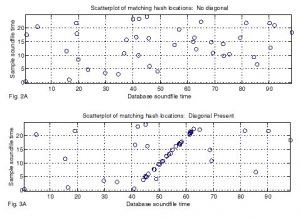
Top graph: Songs and sample have many frequency matches, but they do not align in time, so there is no match. Bottom Graph: frequency matches occur at the same time, so the song and sample are a match. Wang, Avery Li-Chun. An Industrial-Strength Audio Search Algorithm. Shazam Entertainment, 2003. Fig. 2B.

If a specific song is hit multiple times (based on examples in the paper I think it needs about 1 frequency hit per second), it then checks to see if these frequencies correspond in time.  They actually have a clever way of doing this  They create a 2d plot of frequency hits, on one axis is the time from the beginning of the track those frequencies appear in the song, on the other axis is the time those frequencies appear in the sample.  If there is a temporal relation between the sets of points, then the points will align along a diagonal.  They use another signal processing method to find this line, and if it exists with some certainty, then they label the song a match.

Share

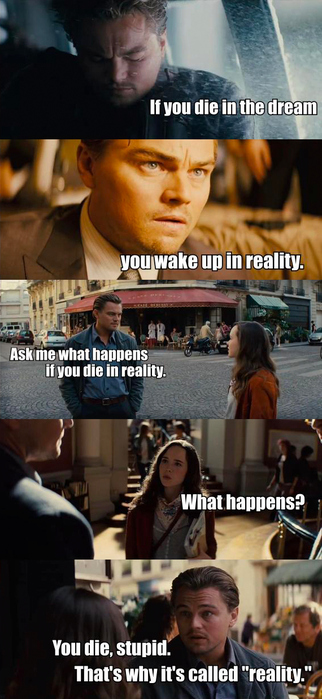
If You Die In Reality

March 13th, 2012, posted in DAtEs iN a YeAR
Share

what happen

Share

Smile On My Face

March 12th, 2012, posted in MESSAGEs
Share

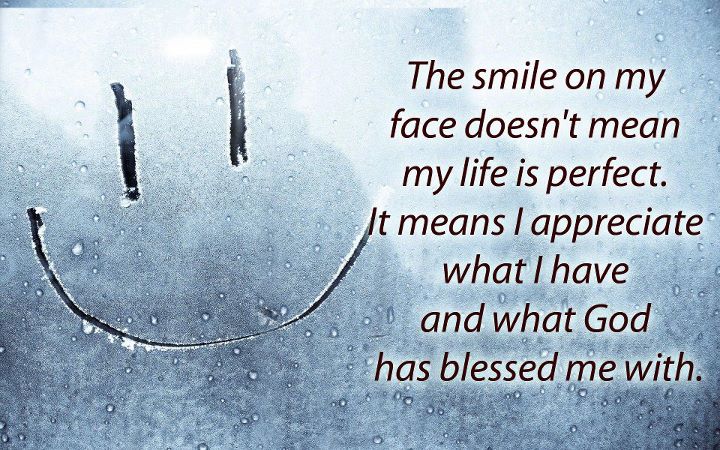
smile on my face

Share

A THIEF IN THE NIGHT

March 11th, 2012, posted in POEtRY.., Rumi, Sufism
Share

A THIEF IN THE NIGHT

Suddenlythief
(yet somehow unexpected)
he arrived
the guest…
the heart trembling
“Who’s there?”
and soul responding
“The Moon…”

came into the house
and we lunatics
ran into the street
stared up
looking
for the moon.

Then-inside the house-
he cried out
“Here I am!”
and we
beyond earshot
running around
calling him…
crying for him
for the drunken nightingale
locked lamenting
in our garden
while we
mourning ring doves
murmured “Where
where?”

As if at midnight
the sleepers bolt upright
in their beds
hearing a thief
break into the house
in the darkness
they stumble about
crying “Help!
A thief! A thief!”
but the burglar himself
mingles in the confusion
echoing their cries:
“…a thief !  “

By : Rumi

Share