ICX:Session Timeout to change the session Timeout in Oracle Apps R122 version:
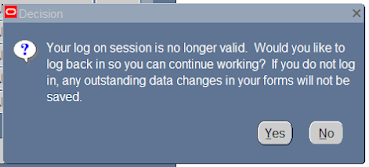
Increase oracle forms session timeout in r122 To change oracle forms session time out via “ICX:session Timeout” Profile in oracle application. ICX:Session Timeout is a profile provided in Oracle apps which controls the time for which a session is valid. Post that time out limit, the user gets below error. Log on session is no longer valid. Would you like to log back in so you can continue working? If you do not log in, any outstanding data changes in your forms will not be saved.
When the user clicks on the Yes button, App opens the login page. Enter the password and login again to continue. Click No to exit from the current session. 30 minutes is the value of this profile in any production instance. It is fine for production instance but for development instance, this may not be ideal, as you will repeatedly get this message and you need to log in again and again. Just increase the value of this profile to avoid the timeout message.
Set ICX:Session Timeout profile
Now let me show how you can change this profile. You can set this profile at the site or user level. It is always better to set at the user level.
Log in to Oracle Apps Instance. Navigate to System Administrator->Profile->System. Query profile the ICX:Session Timeout for the user. The default value is 30 and is set at the site level. We are going to set it a user level. Enter the new value greater than 30 and click on Save. Log off and log in again.
This will make sure that your Oracle apps session will never time out in a smaller interval.
Summary :
ICX:Session Timeout provides an easy way to increase the session limit. It is good to increase only in development or test instance, but production let it be default 30. This tip should work for both Oracle App 11i and R12 release. I hope you found this small tip useful. To set the User Session Timeout, test the following steps in a development instance and then migrate accordingly !!
If suppose we executed autoconfig on application again default value 30 will be added to “ICX:session Timeout” Profile. So we need to change the value in autoconfig file itself. 1. If R12.2 EBS instance view $CONTEXT_FILE change the value for vairable “s_sessiontimeout” in config file then execute the autoconfig.sh in oracle application.
RMAN provided two commands for deleting archive log.
Delete expired archivelog
Backup archive log all delete input
These command can delete archive logs based on the input provided. There were two things that RMAN made sure every time it attempted to delete an archive log. The first is that specified archive log is backed up to all the locations specified under log_archived_dest_n parameters. The value under these parameters can be flash recovery area or non flash recovery area. Second is whether the archive logs to be deleted are obsolete or not. This in turn depends on your backup retention policy. An archive redo log is considered obsolete if it is not required in any recovery scenario.
Using RMAN we can remove the old archvielogs or old backup file using report obsolete or delete obsolete by setting rman rman retention policy :
RMAN> show all; using target database control file instead of recovery catalog RMAN configuration parameters for database with db_unique_name DEV are: CONFIGURE RETENTION POLICY TO REDUNDANCY 1; # default CONFIGURE BACKUP OPTIMIZATION OFF; # default CONFIGURE DEFAULT DEVICE TYPE TO DISK; # default CONFIGURE CONTROLFILE AUTOBACKUP ON; # default CONFIGURE CONTROLFILE AUTOBACKUP FORMAT FOR DEVICE TYPE DISK TO '%F'; # default CONFIGURE DEVICE TYPE DISK PARALLELISM 1 BACKUP TYPE TO BACKUPSET; # default CONFIGURE DATAFILE BACKUP COPIES FOR DEVICE TYPE DISK TO 1; # default CONFIGURE ARCHIVELOG BACKUP COPIES FOR DEVICE TYPE DISK TO 1; # default CONFIGURE MAXSETSIZE TO UNLIMITED; # default CONFIGURE ENCRYPTION FOR DATABASE OFF; # default CONFIGURE ENCRYPTION ALGORITHM 'AES128'; # default CONFIGURE COMPRESSION ALGORITHM 'BASIC' AS OF RELEASE 'DEFAULT' OPTIMIZE FOR LOAD TRUE ; # default CONFIGURE RMAN OUTPUT TO KEEP FOR 7 DAYS; # defaultCONFIGURE ARCHIVELOG DELETION POLICY TO NONE; CONFIGURE SNAPSHOT CONTROLFILE NAME TO 'E:\APP\USER\PRODUCT\12.1.0\DBHOME_1\DATA BASE\SNCFDEV.ORA'; # default RMAN>
Above Configuration show RMAN retention policy is 1, based on this retention policy only report obsolete or delete obsolete will work.
Manually we can remove the expired archive log using below 2 options:
By using this command we can remove the old archive-log manually. Using OS command remove the old archive-log files from the archivelog log location. Move to archivelog location then issue (to find the achive-log location , connect sqlplus / as sysdba ) execute below command to find the archive log.
SQL> archive log list; Database log mode Archive Mode Automatic archival Enabled Archive destination USE_DB_RECOVERY_FILE_DEST Oldest online log sequence 46 Next log sequence to archive 48 Current log sequence 48 SQL> Archvielog location using Flash revoerey area,
SQL> show parameter recover NAME TYPE VALUE ------------------------------------ ----------- ------------------------------ db_recovery_file_dest string E:\app\user\fast_recovery_area db_recovery_file_dest_size big integer 6930M db_unrecoverable_scn_tracking boolean TRUE recovery_parallelism integer 0 SQL>
ARchivelog location is “E:\app\user\fast_recovery_area\dev\ARCHIVELOG”. move to this location and issue command below with 2 options. Recommended options is move the old archivelog file to some other directory wait for 2 days then remove that files. or directly reomove like below rm -rf *.arc or rm -rf (specified archivelog files)
Then issue the command connecting RMAN.
C:\Users\user>rman target /
Recovery Manager: Release 12.1.0.1.0 - Production on Wed Oct 11 17:19:15 2017
Copyright (c) 1982, 2013, Oracle and/or its affiliates. All rights reserved.
connected to target database: DEV (DBID=4027486540)
RMAN>
RMAN> list expired archivelog all;
using target database control file instead of recovery catalog
specification does not match any archived log in the repository
RMAN>
Before crosscheck its shows like this.
RMAN> crosscheck archivelog all;
It will crosscheck the archivelog files with RMAN repository deleted files status changed to expired in RMAN repository.
RMAN> list expired archivelog all;
List of Archived Log Copies for database with db_unique_name DEV
=====================================================================
Key Thrd Seq S Low Time
------- ---- ------- - ---------
39 1 48 X 11-OCT-17
Name: E:\APP\USER\FAST_RECOVERY_AREA\DEV\ARCHIVELOG\2017_10_11\O1_MF_1_
8_DXW2ZZFW_.ARC
RMAN>
Then issue below command to remove from the RMAN repository.
RMAN> delete expired archivelog all;
released channel: ORA_DISK_1
allocated channel: ORA_DISK_1
channel ORA_DISK_1: SID=129 device type=DISK
List of Archived Log Copies for database with db_unique_name DEV
=====================================================================
Key Thrd Seq S Low Time
------- ---- ------- - ---------
39 1 48 X 11-OCT-17
Name: E:\APP\USER\FAST_RECOVERY_AREA\DEV\ARCHIVELOG\2017_10_11\O1_MF_1_4
8_DXW2ZZFW_.ARC
Do you really want to delete the above objects (enter YES or NO)? yes
deleted archived log
archived log file name=E:\APP\USER\FAST_RECOVERY_AREA\DEV\ARCHIVELOG\2017_10_11\
O1_MF_1_48_DXW2ZZFW_.ARC RECID=39 STAMP=957116888
Deleted 1 EXPIRED objects
RMAN>
RMAN> delete noprompt expired archivelog all;
2. Backup archive-log all delete input: Above command will remove the all archive-log file after taking the backup of all archvielog available in current RMAN repository. We have options also It will take backup 2 days before archive-log file and then remove it.
RMAN> backup archivelog until time 'sysdate-2' delete input;
Crosscheck commands :
To crosscheck all backups use:
RMAN> CROSSCHECK BACKUP ;
To list any expired backups detected by the CROSSCHECK command use:
RMAN> LIST EXPIRED BACKUP ;
To delete any expired backups detected by the CROSSCHECK command use:
RMAN> DELETE EXPIRED BACKUP ;
To crosscheck all archive logs use:
RMAN> CROSSCHECK ARCHIVELOG ALL ;
To list all expired archive logs detected by the CROSSCHECK command use:
RMAN> LIST EXPIRED ARCHIVELOG ALL ;
To delete all expired archive logs detected by the CROSSCHECK command use:
RMAN> DELETE EXPIRED ARCHIVELOG ALL ;
To crosscheck all datafile image copies use:
RMAN> CROSSCHECK DATAFILECOPY ALL ;
To list expired datafile copies use:
RMAN> LIST EXPIRED DATAFILECOPY ALL ;
To delete expired datafile copies use:
RMAN> DELETE EXPIRED DATAFILECOPY ALL ;
To crosscheck all backups of the USERS tablespace use:
RMAN> CROSSCHECK BACKUP OF TABLESPACE USERS ;
To list expired backups of the USERS tablespace:
RMAN> LIST EXPIRED BACKUP OF TABLESPACE USERS ;
To delete expired backups of the USERS tablespace:
RMAN> DELETE EXPIRED BACKUP OF TABLESPACE USERS ;
select owner as schema_name,
job_name,
job_style,
case when job_type is null
then 'PROGRAM'
else job_type end as job_type,
case when job_type is null
then program_name
else job_action end as job_action,
start_date,
case when repeat_interval is null
then schedule_name
else repeat_interval end as schedule,
last_start_date,
next_run_date,
state
from sys.all_scheduler_jobs
order by owner,
job_name;
Columns :
schema_name – name of the schema
job_name – name of the job
job_style:
REGULAR
LIGHTWEIGHT
job_type – inline job action type
PLSQL_BLOCK
STORED_PROCEDURE
EXECUTABLE
CHAIN
SQL_SCRIPT
BACKUP_SCRIPT
EXTERNAL_SCRIPT
PROGRAM
job_action – PL/SQL code or program/routine name to call
start_date – when job will be launched first time
schedule – inline schedule PL/SQL expression, calendar string or name of the schedule
last_start_date – last date on which the job started running
next_run_date: next date on which the job is scheduled to run
Achieving Azure certification can enhance your cloud computing career by demonstrating your understanding of cloud fundamentals, as well as Azure’s services, architecture, governance, and management. This guide will explore what the certification entails, its demand in the job market, the benefits it offers, and the steps to obtain Azure certification.
What is Azure certification?
Microsoft Azure is a cloud computing platform designed for IT professionals, developers, and specialists in data and artificial intelligence (AI) who operate within the Microsoft cloud ecosystem. Azure certifications provide training on utilizing various cloud-based services, enhancing your job prospects or helping you advance in your career. Microsoft categorizes Azure certifications into three tiers: Fundamentals, Associate, and Expert. Additionally, there are Specialty certifications available, including Cosmos DB Developer and Virtual Desktop.
Are Azure certifications in demand ?
Cloud computing is rapidly evolving, with an increasing number of companies seeking certified Azure administrators, solution architects, developers, and security engineers. Consequently, Azure certifications are in high demand. The Flexera 2023 State of the Cloud Report indicates that Azure remains the leading cloud provider, closely followed by AWS.
Azure certification Benefits
The advantages of Azure certification include opportunities for career advancement, access to diverse job options, the potential for higher salaries, enhanced skills, and better security solutions for your employer. Let’s explore how obtaining Azure certification can provide these benefits.
Growth In Career
Whether you’re currently working in cloud computing or aiming to enter the field, Azure certification can significantly enhance your career prospects. These certifications are among the most sought after in IT today, helping you secure better job opportunities or advance to higher positions within your organization.
Flexible career pptions
A Microsoft Azure certification opens up numerous career opportunities, allowing you to become a cloud architect, developer, or solution architect. Additionally, this certification enables you to work across various industries and locations.
Companies across various industries are migrating to the cloud due to the advantages in storage, computing, and networking. An Azure certification can open doors to roles in sectors such as healthcare, finance, and entertainment. Furthermore, many certified Azure professionals find opportunities in locations like France, the UK, the United States, and beyond.
Increase Higher Earning
If you pursue an Azure certification at the Fundamentals level, you could earn an average hourly wage of up to $79.81, according to ZipRecruiter. Additionally, data from Glassdoor indicates that Azure certification can enhance your earning potential. For instance, Azure cloud architects have an average annual salary of $133,721 in the US. Here are the salaries for other Azure-certified cloud roles in the US :
Azure DevOps engineer: $126,096
Azure cloud engineer: $119,342
Azure data engineer: $120,387
More specific skill set
The more you know about cloud computing, the more competitive you’ll be in the job market. As highlighted in the salary figures mentioned earlier, individuals with advanced Azure skills tend to earn higher compensation. Azure certification can help you enhance your expertise in areas like artificial intelligence and machine learning.
The certification exams assess various skills, including knowledge of cloud concepts and an understanding of Azure’s core architectural components. Additional skills covered include Azure identity, access and security, as well as governance and compliance.
Improved security
Becoming certified can enhance your company’s cloud security by keeping you informed about the latest trends and options. Renewing your certifications ensures you stay updated on changes and new technologies. This increased security awareness makes you more appealing to employers, particularly for roles focused on cloud security.
Azure certification path
If you’re new to Azure, begin with a Fundamentals exam relevant to your career. After that, you can explore various Associate and Specialty Azure certifications. Ultimately, demonstrate your expertise to current or potential employers by obtaining Expert-level Azure certifications.
Explore the certifications in the table below:
Certification
Level
What it’s best for
Azure AI Fundamentals (AI-900)
Fundamentals
Demonstrating your AI skills on the cloud and the services Azure can offer in this area
Azure Data Fundamentals (DP-900)
Fundamentals
Developing a strong foundation in the core concepts of data and data analytics
Azure Fundamentals (AZ-900)
Fundamentals
Demonstrating your knowledge of cloud concepts, models, and services and showing your expertise in Azure
Azure Administrator Associate (AZ-104)
Associate
Building on subject matter expertise managing an organization’s Microsoft Azure environment
Azure AI Engineer Associate (AZ-102)
Associate
Learning to build, manage, and deploy AI solutions within Azure
Azure Data Engineer Associate (DP-203)
Associate
Storing and using datasets for analysis and managing data pipelines and data stores
Azure Data Fundamentals (DP-900)
Associate
Working with data in the cloud
Azure Data Scientist Associate (DP-100)
Associate
Exploring data science and using Azure Machine Learning and Azure Databricks
Azure Database Administrator Associate (DP-300)
Associate
Managing the operational aspects of data platform solutions built with Microsoft SQL Server and Microsoft Azure Data Services
Azure Developer Associate (AZ-204)
Associate
Building on your cloud developer experience and learning about developing Azure computing and storage
Azure Enterprise Data Analyst Associate (DP-500)
Associate
Building expertise in data analytics solutions, including how to design, create, and deploy them
Azure Network Engineer Associate (AZ-700)
Associate
Validating your knowledge and skills in Azure network solutions planning, implementation, and maintenance
Azure Security Engineer Associate (AZ-500)
Associate
Planning and implementing cloud-based management and security; building on your experience in code, security operations processes, cloud capabilities, and Azure services
Azure Stack Hub Operator Associate (AZ-600)
Associate
Enhancing your skills in providing platform as a service (PaaS) and infrastructure as a service (IaaS) using Azure Stack Hub
Azure DevOps Engineer Expert (AZ-400)
Expert
Building on your experience as an infrastructure administrator or developer, with expertise in DevOps, Azure administration, or development
Azure Solutions Architect Expert (AZ-305)
Expert
Building on your expertise in designing cloud and hybrid solutions that run on Microsoft Azure, as well as your advanced experience and knowledge in IT operations, Azure administration, Azure development, and DevOps processes
Azure Specialty Certifications:
• Azure Support Engineer for Connectivity Specialty (AZ-720) • Azure Cosmos DB Developer Specialty (DP-420) • Azure Virtual Desktop Specialty (AZ-140) • Azure IoT Developer Specialty (AZ-220) • Azure for SAP Workloads Specialty (AZ-120)
How to become Azure certified
Begin your journey to Azure certification by fulfilling the prerequisites for your desired certification level. Next, register for and complete the certification exam. To maintain your certification, remember to renew it annually.
1. Get develop and doing the training of relevant skills.
You can discover Azure courses and training online from various providers. For instance, Coursera offers Azure training courses, including the AZ-900 exam prep specialization, which covers cloud computing, Azure tools and services, security, cloud governance, and more.
Microsoft provides a range of self-paced content for all certification levels and specialty exams. These online learning paths include videos and lessons designed to help you prepare for the certification exam. You can complete these courses for free, or opt for instructor-led classes for a fee.
Microsoft also organizes free events known as Microsoft Azure Virtual Training Days. You can select which events to attend based on your skill level and interests. After completing the related Fundamentals training sessions, you can take the corresponding certification exams for free: Microsoft Azure Fundamentals, Microsoft AI Fundamentals, and Microsoft Data Fundamentals.
Important note:
Regardless of the training courses you choose, whether from Microsoft or other providers, you must complete and pass Microsoft’s examination to achieve Azure certification.
2. Meet the prerequisites for each level.
Each Azure certification outlines recommended skills to acquire before taking the exam. Microsoft’s self-paced or instructor-led content, along with third-party courses, can assist you in gaining the essential skills needed to prepare for the certification exams.
The Fundamentals and Associate certification levels don’t have formal prerequisites, but Microsoft suggests the following steps before attempting an exam :
Have a complete understanding of the skills the exam measures.
For Associate-level exams, have experience in the tested skills.
Take a practice exam provided by Microsoft.
Use Microsoft Azure with a trial subscription.
Take advantage of Microsoft’s learning resources to prepare.
Azure Expert certifications come with prerequisites. To qualify for the Azure Solutions Architect Expert exam, you must first complete the Azure Administrator Associate exam. For the Azure DevOps Engineer Expert exam, you need to have completed either the Azure Administrator Associate or the Azure Developer Associate exam.
3. Pass the certification exam.
Each certification is linked to an exam that you must pass. All technical exams are scored on a scale from 1 to 1,000, with a passing score set at 700 or higher.
4. Maintain your credentials.
Renewing your certification ensures you stay updated on the latest developments in Azure. Fundamentals-level certifications do not require renewal, as they do not expire. To renew your Associate and Expert certifications, you can pass the free online renewal assessment available on Microsoft Learn. These renewal exams focus only on questions about updates in Azure or related technologies from the past year.