Posts Tagged ‘islam’

About Hazrat Ali By Holy Prophet (P.B.U.H)

October 2nd, 2015, posted in DAtEs iN a YeAR, Islamic Teachings, Saying Of Holy Prophet ( P.B.U.H), Sufism, Zul-Haj
Share

The Prophet’s (saw) Kin

When the verse 3:61 was revealed to the Prophet (saw): Now that you know the facts, say to them ‘Come, let us summon our sons and your sons, our women and your women and ourselves and yourselves and pray Allah and beseech Him to accurse those who intentionally assert falsehood’; he summoned Ali, Fatima, Hassan and Hussain and said: “O God, & these are my kin”.


How can a believer not love Ali 

Zirr reported: ‘Ali observed: By Him Who split up the seed and created something living, the Apostle (may peace and blessings be upon him) gave me a promise that No one but a believer would love me, and none but a hypocrite would nurse grudge against me.
Reference: Book 001, Number 0141: (Sahih Muslim)


He whom Allah and His Messenger (saw) love

Narrated Salama: Ali happened to stay behind the Prophet and (did not join him) during the battle of Khaibar for he was having eye trouble. Then he said, “How could I remain behind Allah’s Apostle?” So ‘Ali set out following the Prophet . When it was the eve of the day in the morning of which Allah helped (the Muslims) to conquer it, Allah’s Apostle said, “I will give the flag (to a man), or tomorrow a man whom Allah and His Apostle love will take the flag,” or said, “A man who loves Allah and His Apostle; and Allah will grant victory under his leadership.” Suddenly came ‘Ali whom we did not expect. The people said, “This is ‘Ali.” Allah’s Apostle gave him the flag and Allah granted victory under his leadership.
Reference: Volume 5, Book 57, Number 52: (Sahih Bukhari)


He was to the Prophet (saw) what Haroon (as) was to Musa (as)

Sa’d reported Allah’s Apostle (may peace be upon him) as saying to ‘Ali: Aren’t you satisfied with being unto me what Aaron was unto Moses?
Reference: Book 031, Number 5916: (Sahih Muslim)


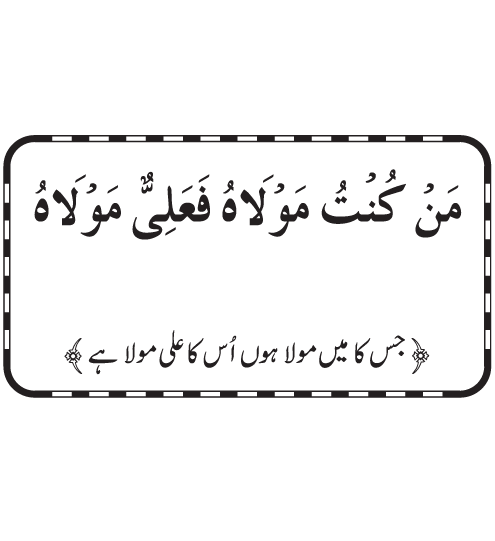
For whosoever is Prophet (saw) Mawla, Ali is Mawla

Sayyidna Abu Sarihah (Radhi Allah) or Zayd ibn Arqam (Shu’bah is uncertain about it) said that Prophet (salallaho alaihi wasalam) said: He for whom I am Mawla (friend, beloved, helper), Ali is Mawla
Reference: Sunan al Tirimdhi Hadith No. 3733 – Imam Abu Isa Tirimdhi (rah) said: This Hadith is “HASAN SAHIH”
 

Share

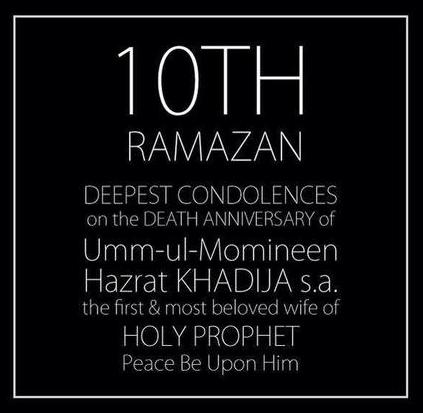
10th Ramazan

June 28th, 2015, posted in Ramazan
Share

Name : Khadija bint-e-Khawailad (SA)Hazrat Aisha,Hazrat Ayesha,Islam ,Islamic Woman,Islamic Women,Sahih Bukhari,Islam,Muslim World,#HazratKhadija (A.S), LadyKhadija ,10thRamzan,10th Ramzan,
Title : Umm-ul-Momineen
Agnomen: Tahira
Father : Khawailad bin Asad
Mother : Fatemah bint-e-Zaedeh
Birth : Makkah
Death : 10th Ramazan 3 years before Hijrah at the age of 64 years. Buried : in Makkah

Birth and Geneology
Hazrat Khadija(SA) was the first wife of the Holy Prophet (pbuh). She was born in Makka. Her father’s name was Khuwaylid bin Asad and he was a wealthy trader.


Early Life
Her mother and father both died within 10 years of each other. Their wealth was divided amongst the children but it was Hazrat khadija(SA) who took over the family business and expanded it. With the profit she made she helped the poor, widows, orphans, sick and the disabled people of Makka.

She had a cousin called Waraqa bin Naufal who was very learned man and who was not an idol worshipper. Both Waraqa and Hazrat Khadija were monothiests and believed in one Allah.

First contact with Prophet Mohammad(pbuh)
Because of her excellent Akhlaq the Arabs (who at that time used to look down upon women) called her Tahira – the pure one. She was also known as the ‘Princess of Makkah’ because of her wealth. A lot of Arab nobles and princess wanted to marry her but she refused all of them.

In 595 AD, Hazrat Khadija was looking for someone to be in charge of her caravan to Syria. Hazrat Abu Talib(AS) suggested the Prophet Mohammad(pbuh&hf) to her. She had heard of his trustworthiness and agreed to employ him although he did not have much trading experience. To help him she sent her slave Maysara.

The trading caravan was a great success and when Hazrat Khadija(SA) heard of the Prophet’s skills and excellent conduct, she became his admirer.

Marriage with Prophet Mohammad(pbuh)
Soon it was arranged for Hazrat Khadija(SA) to be married to the Prophet Mohammad(pbuh&hf). At that time, Prophet Mohammad(pbuh&hf) was aged 25 and Hazrat Khadija(SA) was 40 years of age.

According to Shiite tradition, this was her first marriage and that she was not a widow as is narrated by non-shiite sources. Hazrat Abu Talib(AS) read the Nikah on behalf of the Prophet whilst Waqara bin Noufal read it for Hazrat Khadija.

Hazrat Abu Talib(AS) paid the mehr for his nephew and fed the people of Makka for 3 days in celebration. Hazrat Khadija too fed the people. The marriage was a very happy one and their first child was a son called Qasim. The second was Abdullah. Both died in infancy. Their third and last child was Hazrat Fatema Zahra(SA).

Her services for Islam
When the Prophet used to go to meditate in the cave of Hira on Jabel-e-Noor, it was Hazrat Khadija(SA) herself who would climb up there to give him his food and necesseries. She was the first person to accept Islam as taught by the Prophet(pbuh&hf).

In 616 AD, the Quraish isolated the Bani Hashim (the family of the Prophet) and they took refuge in a ravine called Shib-e-Abu Talib. Hazrat Khadija (SA) was there too and it was her wealth (which she donated for Islam) that sustained the Muslims at that time. The siege lasted for 3 years during which time they experienced hunger, thirst, and the cold and heat of the desert.

Her Death
Hazrat Khadija (SA) was married to the Holy Prophet(pbuh) for 25 years. Shed died in 619 AD on the 10th of Rmazan 3 years before the Hijrah. When she died nothing was left of her wealth – all of it was served for the propagation of Islam.

She was buried in Makkah in a cloak of the Holy Prophet(pbuh). Hazrat Abu Talib(AS) died in this year too. The Prophet(pbuh&hf) called the year Aam-ul-Huzn (the year of grief).

While Hazrat Khadija (SA) lived, the Holy Prophet(pbuh) did not marry another woman and in later years he always said that she was the best of his wives.

 Hazrat Aisha,Hazrat Ayesha,Islam ,Islamic Woman,Islamic Women,Sahih Bukhari,Islam,Muslim World,#HazratKhadija (A.S), LadyKhadija ,10thRamzan,10th Ramzan,

Share

Ramadan and Ghalib

June 24th, 2015, posted in DAtEs iN a YeAR, Ghalib
Share

It is the month of Ramadan and Ghalib has his share of quotes for the season. Ghalib was known for his wit, when asked how many fasts he had kept he is reported to have replied ek na rakha (I did not keep one). Typical Ghalib.

But in his tongue-in-cheek manner Ghalib also pushes his readers to think of many other aspects of a situation than the one that seems obvious on the surface.

Our choice this week reflects this quality of Ghalib:

iftaar-e-saum kii jise kuch dast.gaah ho
us shakhs ko zaroor hai rozaa rakha kare

jis paas roza khol ke khaane ko kuch na ho
roza agar na khaaye to naachaar kya kare

the one who has the wherewithal to break his fast
that person should indeed keep the fast

the one who has nothing to break his fast with
what else can he do but be constrained to ‘eat the fast’

The Ghalib wordplay is obvious to the Urdu reader and the way he sets up the paradox is uniquely his own.

But we can take away a lot more from this set of couplets (qat’aa).

Think of this situation: You observe an individual not eating during the day. You can conclude that the individual is fasting (i.e., not eating out of choice). But it is also possible that the individual is not eating because he or she has nothing to eat (i.e., not eating out of necessity). The person is starving! ‘Eat the fast’ is a nice play here because the colloquial expression signifies not fasting but it is particularly apt in the context for the destitute because eating a fast is equivalent to eating a zero, i.e., eating something that yields no sustenance.

Here we have a profound observation on our understanding of choice. The notion of choice only becomes relevant when our basic necessities are satisfied. Thus we can take the theory of choice for granted in the West. But in a location like South Asia, where almost a third of the population lives below the poverty line, we need to be a lot more conscious of attributing observed behavior to the exercise of free choice. Some fast, others starve – the observed behavior is the same (not eating) but the compulsions leading to that action are entirely different. Some do not eat for a month; others do not eat all year round. What does fasting mean in this context ??

So, Ghalib is educating us to be aware of the context, to not be judgmental, to not think that our own way is the only correct way of behaving, to be empathetic and tolerant, and to understand the reasons that might compel others to behave differently from us.

To be willing to observe the rituals of piety is one thing; to be able to do so quite another. Let one not be judgmental from the luxury of a good sehri and well-laid iftaar table.


source :  https://thesouthasianidea.wordpress.com
Share

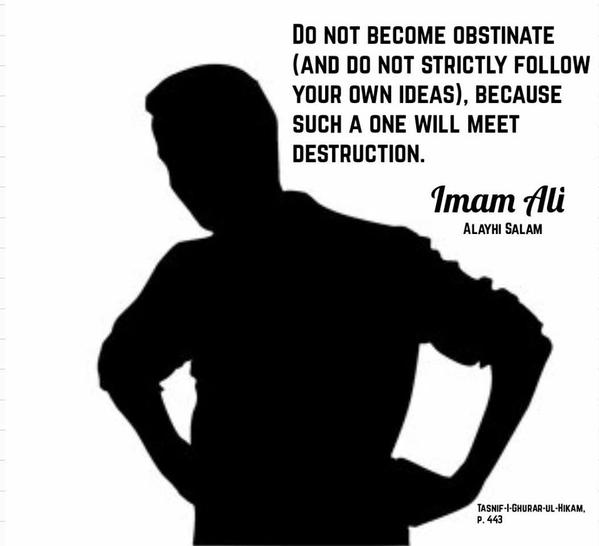
Do not become obstinate because such a one will meet destruction

June 19th, 2015, posted in Islamic Teachings, Saying Of Hazrat Ali ( A.S )
Share

Imam Ali, Obstinate,strictly follow,your own ideas,meet destruction,destruction,Islam,Islamic Saying,Saying of Imam Ali,Quotes of Imam Ali,Quote of Imam Ali,sayings of Imam Ali

Share

What is next to Ecstasy ?

June 4th, 2015, posted in MESSAGEs, Sufism
Share

book, book reading, Ecstasy, Hell, hope, islam, love, muslims, nothingness, novel, pain, peerekamil, What Is Next To Ecstasy ,Ecstasy,What is next to Ecstasy,next to Ecstasy,Umera Ahmed,PeereKamil,Hell,nothingness,pain,grave's silence,

Share