
Posts Tagged ‘poet’



Abu-Al-Asar Hafeez Jalandhuri
June 5th, 2011, posted in PAKiSTAN, POEPLesAbu-Al-Asar Hafeez Jalandhuri writer, poet and above all composer of the National Anthem of Pakistan. He was born in Jalandhar, Punjab, India on January 14, 1900. After independence of Pakistan in 1947, Hafeez Jullundhri moved to Lahore. Hafeez made up for the lack of formal education with self-study but he has the privilege to have some advise from the great Persian poet Maulana Ghulam Qadir Bilgrami. His dedication, hard work and advise from such a learned person carved his place in poetic pantheon.
Hafeez Jullandhuri actively participated in Pakistan Movement and used his writings to propagate for the cause of Pakistan. In early 1948, he joined the forces for the freedom of Kashmir and got wounded. Hafeez Jalandhari wrote the Kashmiri Anthem, “Watan Hamara Azad Kashmir”. He wrote many patriotic songs during Pakistan, India war in 1965.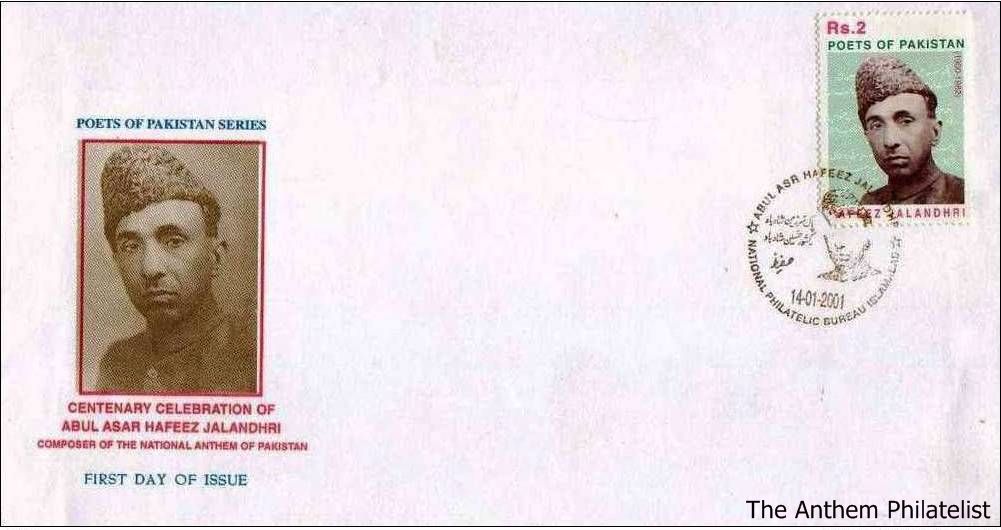
Hafeez Jullandhuri served as Director General of morals in Pakistan Armed Forces, and very prominent position as adviser to the President, Field Marshal Mohammad Ayub Khan and also Director of Writer’s Guild.
Hafeez Jullundhri’s monumental work of poetry, Shahnam-e-Islam, gave him incredible fame which, in the manner of Firdowsi’s Shahnameh, is a record of the glorious history of Islam in verse. Hafeez Jullandhuri wrote the national anthem of Pakistan composed by S.G.Chhagla. He is unique in Urdu poetry for the enchanting melody of his voice and lilting rhythms of his songs and lyrics. His poetry generally deals with romantic, religious, patriotic and natural themes. He chooses his themes, images and tunes from the subcontinent and his language is a fine blend of Hindi and Urdu diction, reflecting the composite culture of South Asia.
Hafeez was born in Jalandhar, India in a Rajput family. His father was Shams-ud-din who was Hafiz-e-Qur’an. He firstly studied in mosque and then got admission in some local school. He got education up to seventh class. He got no more formal education.
Recently, an Indian poet Jagannath Azad, son of Lahore-based poet Tilok Chand Mahroom, claimed that long before Hafeez Jullundhri’s lyrics were adopted as the national anthem in 1950s, Pakistan had an anthem written by him. He was commissioned by Muhammad Ali Jinnah to write the anthem three days before the creation of Pakistan in 1947. After long debates on this issue in Pakistan, researchers have declined Azad’s claim to be the poet of first national anthem of Pakistan. Dr Safdar Mehmood, a famous researcher in Pakistan, has written an article in ‘Daily Jang’ (6 June 2010), researching this topic a bit further. Based on his research, Dr Mehmood suggests that while there might be a possibility that Azad might have written a national (milli) song which was broadcast by Radio Pakistan after 1947, however, there is no evidence of Azad’s meeting with Jinnah nor of the claim that he wrote a national anthem for Pakistan which was approved by Jinnah and which was broadcast by Radio Pakistan as the new country’s national anthem. In fact, there is no record of the broadcast of Azad’s anthem in the official archives of Radio Pakistan. Azad has also claimed that he was awarded ‘Iqbal Medal’ in 1979 by the Government of Pakistan. Again, this claim is not true as his name is not included in the governmental record of national award holders maintained by the Cabinet Division of Pakistan.
He first married in 1917, when he was seventeen years old. His first wife was his cousin “Zeenat Begum”. They altogether had seven children, all of them girls and no boys. In 1939 he married for the second time with a young English woman and had one girl with her. This marriage ended in a divorce. His first wife died in 1954. In 1955 he married with Khurshid Begum. The third relation also gifted him one girl.
In 1922 – 1929 he remained the editor of a few monthly magazines namely, “Nonehal”, “Hazar Dastaan”, “Teehzeeb-e-Niswan”, “Makhzin”. His first collection of poems Nagma-e-Zar was published in 1935. After the World War II, he worked as the director of the Song Publicity Department. During this same time he wrote songs that were much liked by the public.
He died on December 21, 1982 at the age of eighty two years. He was buried in Model Town, Lahore but later on his dead body was re-buried in the tomb near Minar-e-Pakistan.
The Mullah & the Paradise
June 3rd, 2011, posted in Allama Iqbal, ChARACtERs, Ink On PAPER, PAKiSTAN, Scarface'S DIARYDr. Muhammad Allama Iqbal ,who was ardent follower of Rumi, perhaps the greatest Sufi poet of all time, openly criticized the self-proclaimed guides of the religion.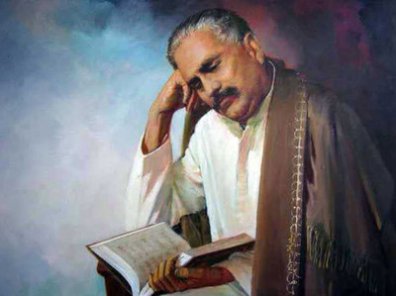
However, it is satirical that mullahs of the same breed quote verses of Iqbal to support their pose, yet his poetry is filled with open disapproval of them.
Anyway..
This is a beautiful translation of Iqbal’s visions about traditional Mullaism..
Our destiny is to promote peace,love and respect in the hearts of everyone regardless of our Mulla’s orthodox visions…
One positive thing about Mullas is that atleast they are keeping our mosques alive 5 times a day…When most of us sleep, Mullas wake up…
I m not taking side with Mullas but infact i am clearing them on a positive note also besides there lot of orthodoxism and stubbornness which should be now ignored by igniting the light of education and awareness in even traditional Mullas…
Here he bashes out at Mullahs in his famous “The Mullah and the Paradiseâ€
When in a vision I saw
A mullah ordered to paradise,
Unable to hold my tongue
I said something in this wise:
‘Pardon me, O Lord
For these bold words of mine,
But he will not be pleased
With houris and the wine
He loves to dispute and fight
And furiously wrangle,
But paradise is no place
For this kind of jangle
His task is to dis-unite
And leave people in the lurch,
But paradise has no temple
No mosque and no church
– translated by Naeem Siddiqui