Posts Tagged ‘Oracle Application’

How To Open Multiple Forms At A Time In Oracle ERP

March 28th, 2018, posted in Oracle
Share

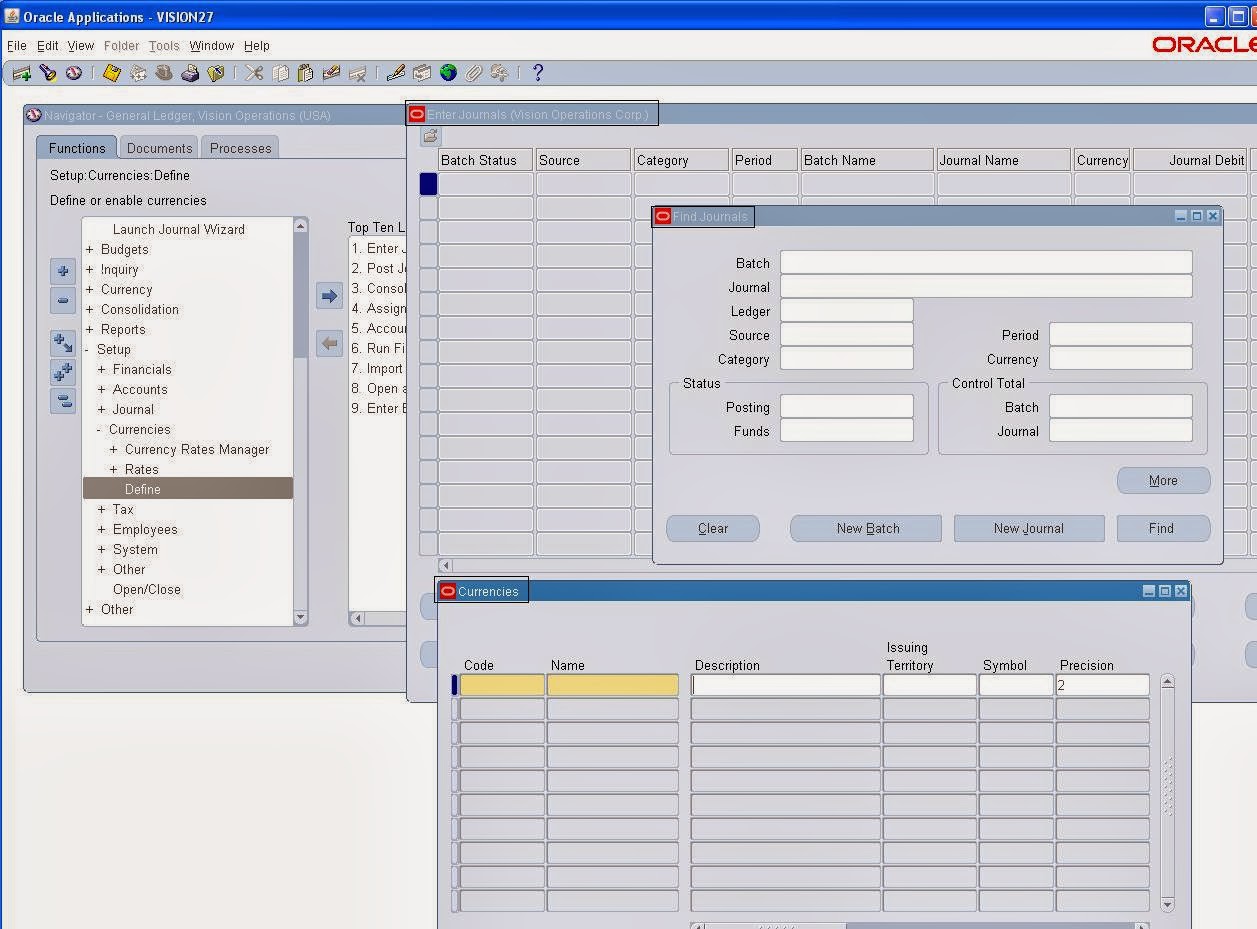
Here I am going to discuss about how we can open multiple forms at a time. Here is a requirement that i want  to open journal entry form as well as currency definition form at a time. Normally we can open one form at a time but by doing below changes we can get this functionality.

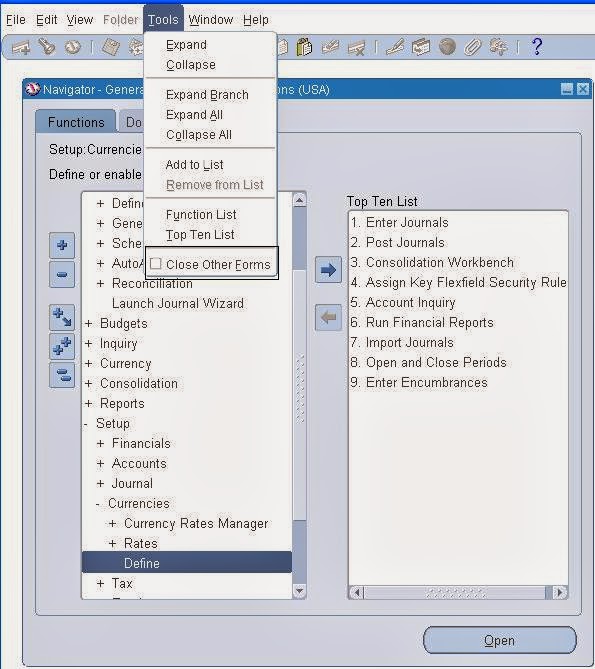
After accessing to the application go to Tools, You can observe that their is a check box checked against “Close Other Forms”.

How To Open Multiple Forms At A Time In Oracle ERP,How To Open Multiple Forms At A Time,Oracle ERP,Oracle ,ERP,Oracle ERP Application,Oracle Application,Oracle DBA,Oracle Forms,How To Open Multiple Forms Oracle Application


Uncheck the check box

How To Open Multiple Forms At A Time In Oracle ERP,How To Open Multiple Forms At A Time,Oracle ERP,Oracle ,ERP,Oracle ERP Application,Oracle Application,Oracle DBA,Oracle Forms,How To Open Multiple Forms Oracle Application

After unchecking the check box i am trying to open the journal entry form and currency definition form. You can observe that both forms open parallel. for opening both forms click on respective navigation separately.

How To Open Multiple Forms At A Time In Oracle ERP,How To Open Multiple Forms At A Time,Oracle ERP,Oracle ,ERP,Oracle ERP Application,Oracle Application,Oracle DBA,Oracle Forms,How To Open Multiple Forms Oracle Application

Share

Third Party Control Segment Qualifier its Options and Usage

March 22nd, 2018, posted in Oracle
Share

In General Ledger. When we define values in Natural Account. We assign segment qualifiers. Among Segment Qualifiers. “Third Party Control” Segment Qualifier is one of the Qualifier. Today i am sharing the information on Third Party Qualifier.

1. What is meant by “Third Party Control”?

Ans. When we assign or enable “Third Party Control Segment Qualifier”. Here assigning or enabling means select option as “Yes” or “Supplier” or “Customer”. By using that natural account if journal is created then journal should contain “Party Information”. Party Information will be available for a journal when it is created from Sub-Ledgers. Incase Party information is missing for that natural account then the Accounting Program completes in error stating ” Party Information missing”. Normally for manual journals party information will not be available.

2. Who are all parties?

Ans. In R12 as per TCA all the suppliers and customers are treated as Parties.

3. What all the options available in “Third Party Control Segment Qualifiers”?

Ans. Prior to R12.1.3 version there are 4 options. They are

a. No (Default Value)
b. Yes
c. Supplier
d. Customer

In R12.1.3 one additional option is included it is

e. Restrict Manual Journals.

4. What is the Importance of the options available in “Third Party Control Segment Qualifiers”?

Ans.

Value “NO”

If we select option “No” means we are not using Third Party Control Segment Qualifier.

Value “Yes”

If we select option as “Yes” it means that value can be used in AP Sub Ledger (Supplier information is Available) and as well as in AR (Customer Information is available)

Value “Supplier”

If we select option as “Supplier” it means we are going to use this value in AP (Where Supplier information is available)

Value “Customer”

If we select option as “Customer” it means we are going to use this value in AR (Where Customer information is available)

Value ” Restrict Manual Journals”

If we select option as ” Restrict Manual Journals” where we can use this value in sub-ledger (With or with out party information ). But we can not use this value in General Ledger for Manual Journals.


Oracle ERP,Oracle ,ERP,Oracle ERP Application,Oracle Application,Oracle DBA,Oracle Forms,racle Apps,Apps DBA,Create Accounting concurrent program,Create Accounting, concurrent program,Third Party Control Segment Qualifier its Options and Usage,Third Party Control Segment Qualifier ,Options and Usage


5. Why  in R12.1.3 version New Option “Restrict Manual Journals” Option introduced?

Ans. Before R12.1.3 if we enabling Third Party Control for the value (Unidentified Cash) and by using the same value if we book Unidentified Receipt. We face issue while performing Create Accounting with error message (party information missing). Which is a bug because we book unidentified receipt where party information is not available. To over come this issue Oracle introduced new value called “Restrict Manual Journals”. By enabling this option we can create journals from sub ledger with out party information but we cannot book manual journal from General Ledger (GL) for the same value.

6. What is the use of “Third Party Control Segment Qualifier”

Ans If we are not enabling or not using “Third Party Control Segment Qualifier” for Control Accounts then we face issues while performing Reconciliation from Sub ledger to GL. Normally we perform periodical reconciliation for control accounts from sub ledger to GL. Due to non enabling “Third Party Control Segment Qualifier” user may pass manual journal entries using control account which will cause difference from Sub ledger to GL. To over come these issue it is suggested to enable “Third Party Control Segment Qualifier” for control Accounts.

7. In which all sub ledgers we can use “Third Party Control Segment Qualifier” for control accounts?

Ans. Prior to R12.1.3 we can use “Third Party Control Segment Qualifier” for control accounts related to Accounts Payables (AP) and Accounts Receivables (AR). But after R12.1.3 due to new option “Restrict Manual Journals” option we can use in all sub ledgers.


Share

APP-PAY-06153 System Error Procedure INITFORMS at Step 1

February 18th, 2018, posted in Oracle
Share

Problem : 


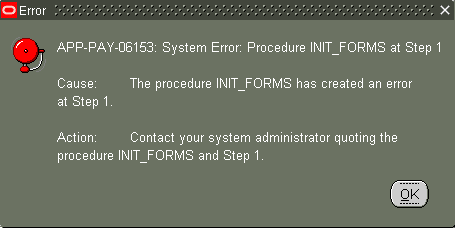
APP-PAY-06153: System Error : Procedure INIT_FORMS at Step 1

Cause: The procedure INIT_FORMS has created an error at Step 1.

Action : Contact your system administrator quoting the procedure INIT_FORMS and Step 1.

APP-PAY-06153,System Error,Procedure INIT_FORMS at Step 1,Step 1,Oracle Appps Error,APP-PAY Error,APP PAY 06153,Oracle Administrator,Oracle Apps,Oracle Application,Oracle EBS,Oracle Apps DBA,Oracle DBA,the procedure INIT_FORMS


Solution :

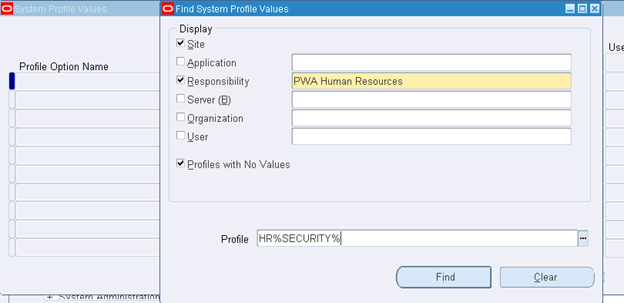
Navigate : System Administrator->Profile->System

APP-PAY-06153,System Error,Procedure INIT_FORMS at Step 1,Step 1,Oracle Appps Error,APP-PAY Error,APP PAY 06153,Oracle Administrator,Oracle Apps,Oracle Application,Oracle EBS,Oracle Apps DBA,Oracle DBA,the procedure INIT_FORMS

Click find

APP-PAY-06153,System Error,Procedure INIT_FORMS at Step 1,Step 1,Oracle Appps Error,APP-PAY Error,APP PAY 06153,Oracle Administrator,Oracle Apps,Oracle Application,Oracle EBS,Oracle Apps DBA,Oracle DBA,the procedure INIT_FORMS

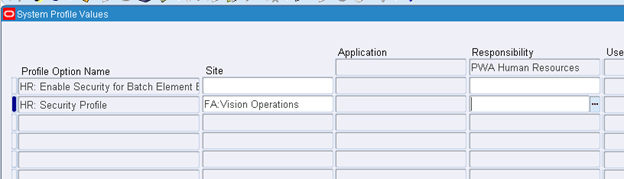
Assign Site: FA: Vision Operations

Save and close

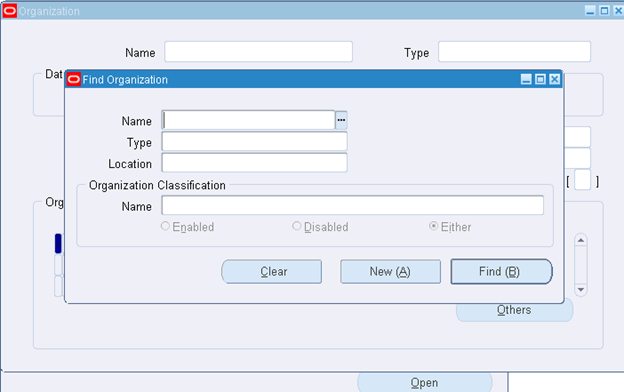
Navigate:->Human Resource->Work Structure->Organization

APP-PAY-06153,System Error,Procedure INIT_FORMS at Step 1,Step 1,Oracle Appps Error,APP-PAY Error,APP PAY 06153,Oracle Administrator,Oracle Apps,Oracle Application,Oracle EBS,Oracle Apps DBA,Oracle DBA,the procedure INIT_FORMS

Form is opened

Share

Clearing Cache In R12

January 3rd, 2018, posted in Oracle
Share

For clearing EBS middle tier cache :

Login to front end application.
Navigate to Functional Administrator responsibility 
Click on (Core Services) Tab
Click on Caching Framework
Select ‘Global Configuration’ on left side menu
Clear All Cache

Finally Bounce the apache and oacore services.

Share

How To Change Java Heap Size In R12 To Avoid Java.Lang.OutOfMemoryError: Java Heap Space Error?

December 24th, 2017, posted in Oracle, Solaris
Share

Recently we had encountered a situation, wherein end users where not able to get the R12 login page and
it just hangs, but all the opmn processess were up and running – adopmnctl.sh status gives status as
alive for all the components viz., HTTP, oafm, oacore & forms. The same environment was available and
end users were able to access without any isuses 15 minutes before. This error happens only when
multiple people login to the same page and perform simillar activity like employee self service form
etc. So where and what exactly could be the problem.

This is how we approached and resolved the issue.

First we checked apache error log. The following error was reported in the error log.

==============================================================
[warn] [client IP Address ] oc4j_socket_recvfull timed out
[error] [client IP Address ] mod_oc4j: There is no oc4j process (for destination: application://oacore) available to service request.
[error] [client  IP Address] mod_oc4j: request to OC4J [servername:OC4J AJP Port Range for Oacore]
failed: Connect failed
==============================================================

Above error message does give us a hint that the problem is with oacore, but as i said earlier the oacore is alive according to opmn.

Next, we verified the oacore log file.

($INST_TOP/logs/ora/10.1.3/opmn/oacore_default_group_1/oacorestd.err)

Error Message in the file

=======================================================
Exception in thread “OC4JMonitorThread” java.lang.OutOfMemoryError: Java heap space
=======================================================

While checking the error in file, parallely we opened another window to see the CPU and memory usage and we could see one java process was taking more than 100% CPU. This process was spawned by the opmn -d process and the process id didnt match with the oacore process id. Hint: adopmnctl.sh status will give the status as well the process id. It looked like a end client java process.

At this stage we had 3 options.

1. Kill the java process which is consuming high cpu.
2. Bounce oacore component
3. Adjust java (jvm) memory parameters

Each of the above options has its own implications and advantages. To minimize the downtime we decided  to kill the java processes, and the moment we killed the java process, all the browsers which were hanging reported instantaneously Internal Server Error. This proved to be a bad decision.

So we moved to the next option, bouncing the oacore service which we are sure will resolve the issue  (temporarily) and it did as expected. Basically when you bounce the services all the existing
connections and processess will be released which results in more available memory when you re-start the services.

Ok, now we tackled the problem and provided a temporary solution but we need to find a long term solution. This is option 3, adjusting java memory size.

Steps to change the heap size.

First, you need to identify how much is the maximum heap size that you can set. Click here.

Once you had identified the maximum heap size, we need to change the configuration files to make it
permanent.

Step 1: Edit opmn.xml file.

Location : $INST_TOP/ora/10.1.3/opmn/conf/

Open opmn.xml

Search for string Xms or Xmx or module-id=”OC4J”

This search should lead you to below location

‘<‘process-type id=”oacore” module-id=”OC4J” status=”enabled” working-dir=”$ORACLE_HOME/j2ee/home”‘>’
‘<‘category id=”start-parameters”‘>’
‘<‘data id=”java-options” value=”-server -verbose:gc -Xmx512M -Xms128M ……]

The default value for Maximum (-Xmx) and Minimum (-Xms) heap sizes are 512M and 128M respectively.

Again here you have options, you can set both Xms and Xmx has the same value as Xmx if you feel all your sessoins require higher memory or set a lower value for Xms and the maximum value for Xmx. Dont forget to change the values under ‘<‘category id=”stop-parameters”‘>’

opmn.xml also contains jvm configurations for other components – oafm & forms.

Step 2: Edit oc4j.properties file.

Location : ($INST_TOP/ora/10.1.3/j2ee/oacore/config)

This step is optional since we had already made changes in opmn.xml but there is no harm in making the change here. This step will come handy for troubleshooting specific components of Oracle viz., configurator, iSupplier or any other option which heavily utilizes/consumes CPU/memory.

Search for string Xms or Xmx or wrapper.

Option 1: If you find any of the above parameters change the values corresponding to the value you had  mentioned in opmn.xml or even more than that, as long as you dont exceed the maximum heap size limit.

Option 2: If you DO NOT find any of the above parameters, then make an entry like this, under the heading “# Java Object Cache Configuration Parameters”

wrapper.bin.parameters=-Xms[Value]M -Xmx[Value]M -XX:NewSize=256M -XX:MaxNewSize=256M

Step 3: Edit Applications Context file

vi $CONTEXT_FILE

Location: $INST_TOP/appl/admin/SID_hostname.xml

search for string s_oacore_jvm_start_options

Change Xms and Xmx value. Repeat the same step for parameter s_oacore_jvm_stop_options.

Changes made in Step 3 will take effect the next time you run autoconfig, whereas Step 1 & 2 changes will take effect the next time you bounce opmn services, but the values are not permanent in the sense these will be wiped off next time you run autoconfig. Yes you can preserve the changes by placing it inbetween Begin and End customizations.

You can also increase the Garbage Collection threads parameter (-XX:ParallelGCThreads) to a higher value if you have JDK 1.5 or more than 2 cpus or more memory. For more information on this you can refer to Metalink Note: 362851 – Guidelines to setup the JVM in Apps Ebusiness Suite 11i and R12.

Share