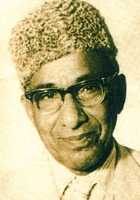
 Abu-Al-Asar Hafeez Jalandhari (Urdu: ابو الاثر حفیظ جالندھری) Pakistani writer, poet and, above all, composer of the National Anthem of Pakistan. He was born in Jalandhar, Punjab, British India on January 14, 1900. After independence of Pakistan in 1947, Hafeez Jalandhari moved to Lahore. Hafeez made up for the lack of formal education with self-study but he has the privilege to have some advise from the great Persian poet Maulana Ghulam Qadir Bilgrami. His dedication, hard work and advise from such a learned person carved his place in poetic pantheon.
Hafeez Jalandhari actively participated in Pakistan Movement and used his writings to propagate for the cause of Pakistan. In early 1948, he joined the forces for the freedom of Kashmir and got wounded. Hafeez Jalandhari wrote the Kashmiri Anthem, “Watan Hamara Azad Kashmir“. He wrote many patriotic songs during Pakistan, India war in 1965.
Hafeez Jalandhari served as Director General of morals in Pakistan Armed Forces, and very prominent position as adviser to the President, Field Marshal Mohammad Ayub Khan and also Director of Writer’s Guild.
Hafeez Jalandhari’s monumental work of poetry, Shahnam-e-Islam, gave him incredible fame which, in the manner of Firdowsi’s Shahnameh, is a record of the glorious history of Islam in verse. Hafeez Jalandhari wrote the national anthem of Pakistan composed by Ahmed Ghulamali Chagla also known as Ahmed G Chagla. He is unique in Urdu poetry for the enchanting melody of his voice and lilting rhythms of his songs and lyrics. His poetry generally deals with romantic, religious, patriotic and natural themes. He chooses his themes, images and tunes from the subcontinent and his language is a fine blend of Hindi and Urdu diction, reflecting the composite culture of South Asia.
Early life
Hafeez was born in Jalandhar, British India to a Rajput family. His father was Shams-ud-din who was Hafiz-e-Qur’an. He firstly studied in mosque and was then admitted in a local school. He then received formal education up until seventh grade (class).
Recently, another poet Jagannath Azad, son of Lahore-based poet Tilok Chand Mahroom, claimed that long before Hafeez Jalandhari’s lyrics were adopted as the national anthem in 1950s, Pakistan had an anthem written by him. He was commissioned by Muhammad Ali Jinnah to write the anthem three days before the creation of Pakistan in 1947. After long debates on this issue in Pakistan, researchers have declined Azad’s claim to be the poet of first national anthem of Pakistan.Dr Safdar Mehmood, a famous researcher in Pakistan, has written an article in ‘Daily Jang’ (6 June 2010), researching this topic a bit further. Based on his research, Dr Mehmood suggests that while there might be a possibility that Azad might have written a national (milli) song which was broadcast by Radio Pakistan after 1947, however, there is no evidence of Azads meeting with Jinnah nor of the claim that he wrote a national anthem for Pakistan which was approved by Jinnah and which was broadcast by Radio Pakistan as the new countrys national anthem. In fact, there is no record of the broadcast of Azad’s anthem in the official archives of Radio Pakistan. Azad has also claimed that he was awarded ‘Iqbal Medal’ in 1979 by the Government of Pakistan. Again, this claim is not true as his name is not included in the governmental record of national award holders maintained by the Cabinet Division of Pakistan.
Spiritual life
Hafeez Jalandhary was a child when he met Maulana Nawab ud din Ramdasi (1870-1946), a great saint of sub continent.Hafeez was reciting Naats in a mesmerizing voice.Maulana stopped and asked Hafeez about his occupation.Hafeez answered he left education and is very poor.Maulana took Hafeez with himself to Ramdas.Hafeez lived with Maulana a lot of years.Hafeez fell in so devotion with Maulana that they became a traditional follower (Mureed) of Maulana Ramdasi and attached himself till last breath.Hafeez was so devoted and love ful to his spiritual guider(Murshid) that according to shorish kashmiri , Hafeez and Haji Laq Laq used to sing spiritual verses and Qawwalis to Hazrat Khawaja Nawab Ud din.In “Shamsheer o Sana” , Hafeez expressed his feelings in a classical way.Hafeez Jalandhari , Haji Laq Laq and Mulana murtaza khan Maikash were famous lovers of Maulana Ramdasi.
Marriage
He first married in 1917, when he was seventeen years old. His first wife was his cousin “Zeenat Begum”. They altogether had seven children, all of them girls and no boys. In 1939 he married for the second time with a young English woman and had one girl with her. This marriage ended in a divorce. His first wife died in 1954. In 1955 he married with Khurshid Begum. The third relation also gifted him one girl. Her name is Raza Hafeez and after getting married she became Raza Riaz.
Later life
In 1922–1929 he remained the editor of a few monthly magazines namely, “Nonehal”, “Hazar Dastaan”, “Teehzeeb-e-Niswan”, “Makhzin”. His first collection of poems Nagma-e-Zar was published in 1935. After the World War II, he worked as the director of the Song Publicity Department. During this same time he wrote songs that were much liked by the public.
Death
He died on December 21, 1982 at the age of eighty two years. He was buried in Model Town, Lahore but later on his dead body was re-buried in the tomb near Minar-e-Pakistan.
Awards
For his literary and patriotic services he was awarded with the most prestigious awards of Hilal-e-Imtiaz and Pride of Performance.
Hymn of Kashmir
A patriotic poetic song of Watan hamara Kashmir, is considered to be the official regional State anthem or State song for Azad Jammu and Kashmir, it was written in the mid-1960s, which was inspired by the conflict of Indo-Pak war II.
Azads lyrics Ae sarzameene paak/Zarray teray haen aaj sitaaron se taabnaak/ Roshan hai kehkashaan se kaheen aaj teri khaak/Ae sarzameene paak (Oh land of Pakistan, the stars themselves illuminate each particle of yours/rainbows brighten your very dust) were replaced six months after Jinnahs death in September 1948. The National Anthem Committee chose Hafeez Jalandharis poem from among 723 submissions.
Shahnam-e-Islam
His monumental work of poetry, Shahnama-e-Islam gave him incredible fame which, in the manner of Firdowsi’s Shahnama, is a record of the glorious history of Islam in verse. Hafeez Jullandhari wrote the national anthem of Pakistan composed by S.G.Chhagla. He is unique in Urdu poetry for the enchanting melody of his voice and lilting rhythms of his songs and lyrics. His poetry generally deals with romantic, religious, patriotic and natural themes. He chooses his themes, images and tunes from the subcontinent and his language is a fine blend of Hindi and Urdu diction, reflecting the composite culture of South Asia.
Through this, I believe Jinnah Sahab wanted to sow the roots of secularism in Pakistan, read a post that quoted Azad. The debate comes at a time when Pakistanis are having a fresh look at the role played by Jinnah in the partition, thanks to a new biography of the countrys founder penned by former BJP leader Jaswant Singh.
He first married in 1917, when he was seventeen years old. His first wife was his cousin Zeenat Begum. They altogether had seven children, all of them girls and no boys. In 1939 he married for the second time with a young English woman and had one girl with her. This marriage ended in a divorce. His first wife died in 1954. In 1955 he married with Khurshid Begum. The third relation also gifted him one girl.
In 1922 — 1929 he remained the editor of a few monthly magazines namely, Nonehal, Hazar Dastaan,Teehzeeb-e-Niswan, Makhzin. His first collection of poems Nagma-e-Zar was published in 1935. After the World War II , he worked as the director of the Song Publicity Department. During this same time he wrote songs that were much liked by the public.