

Posts Tagged ‘Pakistan’

The Men Who Would Lead Pakistan
May 11th, 2013, posted in Ink On PAPER, PAKiSTAN
The current Pakistani government, led by the Pakistan People’s Party (PPP), ends its term on March 18. The government is expected to announce a date for elections before the end of its term. Once the election date is set, the National Assembly will automatically dissolve and a caretaker government will assume charge for up to ninety days before the election.
On polling day, Pakistanis will elect 272 representatives to the National Assembly and 577 representatives to provincial assemblies in Sindh, Khyber Pakhtunkhwa, Punjab, and Balochistan. The political party that secures 172 seats in the National Assembly, either independently or in coalition with other parties, will lead the next government.
Politics is a riddled and opaque game in Pakistan, a point driven home by former politician-turned preacher Tahir-ul Qadri, who despite his absence from Pakistani politics for eight years, was able to lead a 50,000-strong march into Islamabad last month pushing for electoral reforms – and actually won the government’s commitment on some counts. Things are about to get even more complicated as the country prepares for national elections.
The campaign landscape is littered with the typical coterie of political party stalwarts, children of political dynasties, technocrats, and current and former army generals looking to shape the elections outcome. But three individuals stand out as possible leaders of Pakistan’s next government – Asif Ali Zardari, Nawaz Sharif, and Imran Khan. Zardari and Sharif represent the old guard of politics – Zardari the widower of a political dynast and Sharif an industrialist from the country’s breadbasket of Punjab. Khan claims to represent a new political wave, seeking to capture the desires of roughly 18 million new voters, young people who grew up watching Khan win cricket matches for the Pakistani national team. The profiles of the three men who would lead Pakistan promise elections that will be as entertaining as they will be historic.
Asif Ali Zardari, President of Pakistan and Co-Chairman of the Pakistan People’s Party
Who is he? Asif Ali Zardari has been a fixture in Pakistani politics since 1987, when he married Benazir Bhutto, the country’s first female Prime Minister in 1988 and again in 1993. He hails from Sindh but is originally of Baloch ethnic origin. Because of his complicated past, checkered with imprisonment, exile and allegations of corruption, Zardari was viewed as an “accidental president” when he came into power in 2008 following his wife’s assassination. As a result, his emergence as a masterful strategist of a complicated coalition was a surprise to many. He shares the PPP chairmanship with son Bilawal.
What does he want? Zardari’s presidential term ends in September, several months after the national elections are expected. It is only fair to presume he wants to serve another term as President. The PPP’s strength in the Senate, where it won a majority in the March 2012 elections, will help but Zardari won’t be able to take home the prize so easily. An electoral college consisting of the Senate, provincial assemblies and the National Assembly actually elect the president. Zardari’s chances will be determined by both national and provincial assembly elections taking place this year. He also likely wants to keep benefitting from the financial opportunities available to Pakistani politicians in power. But beyond personal power and money, Zardari also seeks to maintain PPP’s strength so that his son, Bilawal, can eventually assume charge and continue the Bhutto family political legacy.
Pro: Zardari’s number one strength remains his ability to make deals in a tough coalition environment, which is expected to continue in the next government. Whether it was meeting Muttahida Quami Movement demands to reverse fuel price hikes in order to stay in the coalition, the unanimous passage of the historic 18th amendment devolving power to the provinces, or re-opening NATO routes closed after a NATO airstrike killed several Pakistani soldiers, he wasn’t too proud to beg to get what he wanted.
Con: Everyone seems to be working against him. Among his “enemies” are the military, judiciary, opposition parties, the Saudis – and the list goes on. Another five years of Zardari could also mean another five years of attempts to unseat him with corruption cases at the Supreme Court, soft coup attempts by the military, and gridlock on economic reform.
Nawaz Sharif, President of Pakistan Muslim League – Nawaz
Who is he? Mian Muhammad Nawaz Sharif is the President of the Pakistan Muslim League – Nawaz (PML-N). A former two-time Prime Minister, Sharif is also a Punjab-based industrialist whose family’s real estate and agriculture holdings are valued at over $100 million. Like Zardari, he has strained ties with the military and judiciary, institutions that aided his eventual ouster in 1999, ironic since Sharif got his start under military dictator General Zia-ul Haq in the 1980s. His two tenures as Prime Minister (1990-1993 and 1997-1999) each straddled the governments of Benazir Bhutto, making for an intense rivalry between the PML-N and PPP that continues to this day, despite recent collaboration between the two parties.
What does he want? The third time’s the charm – or at least Sharif hopes. Another go at Prime Minister would not only allow Sharif to make history – no one else has held the position three times – but it would also bring him back into the mainstream political fold. After Musharraf removed him from power in 1999, Sharif remained in political exile in Saudi Arabia until 2007. Since then, under his leadership the PML-N opposition has criticized the current government’s policies but within apparently self-imposed boundaries, probably to avoid being viewed as “derailing democracy” at a time when disruptions to civilian rule are extremely unpopular.
Pro: Sharif brings along with him the most organized party structure in the country. Even though it lacks the national base that PPP boasts, the PML-N has focused on improving internal governance, strengthening development projects in key constituencies, identifying electable candidates to run on the PML-N ticket, and engaging new young and middle class voters.  Â
Con: He talks to terrorists – sort of. One of the largest vote banks for the right of center PML-N is southern Punjab, a hotbed of violent extremist activity in madrassas run by jihadist and sectarian outfits such as Sipah-e-Sihaba Pakistan, Lashkar-e-Jhangvi, Jaish-e-Muhammad, and Lashkar-e-Taiba. The PML-N cannot ignore the massive base these groups yield in Punjab, which elects 148 out of 272 National Assembly members. In 2010, PML-N Provincial Law Minister Rana Sanaullah reportedly visited the Sipah-e-Sihaba madrassa and met with its leader while campaigning in by-elections. Such relations suggest that a PML-N-led government could be more inclined to offer unsavory characters various concessions in exchange for votes, keeping the peace or achieving other objectives for that matter.
Imran Khan, Chairman of Pakistan Tehreek-e-Insaf
Who is he? Imran Khan is a former captain of the Pakistan cricket team, philanthropist, and now chairman of his own political party, the Pakistan Tehreek-e-Insaf (PTI). His claim to represent anew style of politics is somewhat disingenuous. He follows a long line of South Asian celebrities turned politicians whose personage offers unquestionable advantages in an otherwise complicated political landscape. But his popular appeal is legitimate. Khan has managed to deliver thousands of people at numerous countrywide rallies around the 2013 elections despite the fact that PTI only ever held one seat in the National Assembly..
What does he want? The PTI’s meteoric rise in popularity over the past couple of years has raised suspicions that it enjoys some kind of support from the security establishment, and therefore would simply serve as a mouthpiece for military interests in domestic and foreign affairs. But a simpler answer is perhaps more logical – that Khan has truly tapped into a desire for change in Pakistan, similar to the circumstances surrounding the Qadri march on Islamabad in January, and is keen to see how far it will take him.
Pro: Khan’s call for an overhaul of status quo politics in Pakistan is a welcome one, particularly among urban, educated middle class voters in Punjab. The party manifesto calls for an end to “VIP culture” in Pakistan, noting that corruption at the highest levels has made democratic institutions “the focus of public scorn and ridicule.” It is hard to disagree with PTI’s message when Pakistan consistently ranks among the world’s most corrupt nations.
Con: Despite PTI’s existence as a party for almost sixteen years now, both the party’s manifesto and its leader are untested. Rumors of its internal leadership challenges, weak presence at the provincial level, and Khan’s periodic media stunts (i.e. the march to Waziristan), should raise questions about PTI’s ability to deliver on its ambitious agenda for change.
As the competition between Zardari, Sharif and Khan unfolds over the next several months, other personalities and institutions will also contend to shape and influence the electoral outcome. Let’s not forget the likes of Tahir-ul Qadri, activist Supreme Court Chief Justice Iftikhar Chaudhry, the military, and even the media, all of whom have a say in who leads the next government. In a place where personalities dominate politics, Zardari, Sharif and Khan clearly stand out, but vested interests combined with the rise of new forces of change can put a serious spanner in the works.
Shamila N. Chaudhary is a South Asia analyst at the Eurasia Group and a senior fellow at the New America Foundation. She served as director for Pakistan and Afghanistan at the White House National Security Council from 2010-2011.
Why Cant I Vote No One ?
May 10th, 2013, posted in Ink On PAPER, PAKiSTAN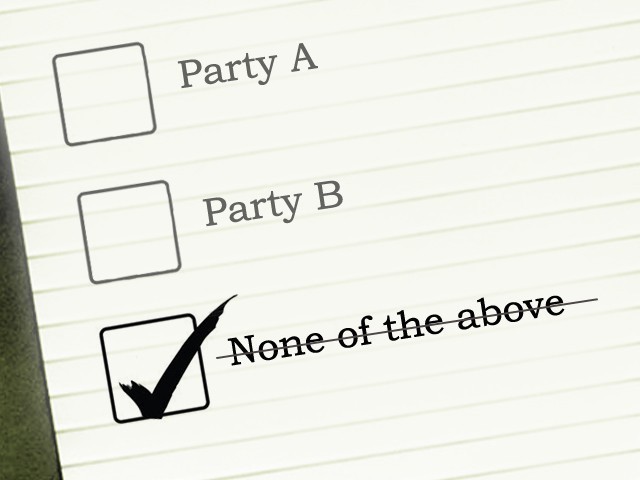
An Article Must Read :
You know what, Election Commission of Pakistan (ECP), I wanted to exercise the ‘none of the above’ option in my vote but you backed out by deciding against introducing it.
I don’t know, nor do I care if I was alone in rejoicing the commission’s decision to put in that option in the ballot paper, because for the first time, I thought I would go and vote my heart out.
I would rather go to the ballot and tell the world that none of these people represent me. This is so much better than just sitting back and not casting one’s vote at all.
For the first time, I thought I had a chance to vent my anger and my disagreement with the people for whom I was nothing but a vote, the people who would refuse to even recognise me after getting elected as my ‘representative’. No sir, this was not against the ‘system’. It was against the people who have been infecting this system, not letting it grow for decades.
Nor was it against ‘democratic norms’. Why would it be?
I have the right to reject anyone, or all who I believe are incapable of representing me.
Why would anyone, in a democracy, not let me reject all those who I believe were not even aware of my name, my needs, who do not share my problems and were least bothered to share them?
Some argued that run off polls resulting from more people exercising the ‘none of the above’ option would prove an extra financial burden. Sir, this is our money that is being spent on electing our future representatives, the people who we have to entrust with making laws for us to make our lives happier.
Let it be spent a hundred times until we get the right person. A wrong choice would deprive us of our hard earned money by corruption anyway.
Others, particularly the politicians who felt threatened by the ECP’s decisions, said it would be ‘anti-democracy’ and would undermine the politicians. They said no one has a right to reject in a democracy.
These self-appointed politicians need to know that more than ‘accepting’, it is the rejecting that people have the right to. So this time again, I will not vote because I do not want to vote for the ‘lesser evil’.

Lyrics/Translation of Dannah Pah Danna by Akhtar Channal and Komal Rizvi
May 4th, 2013, posted in LYRiCS A shepherd introduces his beloved to the wonders of his land, invoking famous rivers and mountains of Balochistan. Through this patriotic anthem, imbued with shades of a pastoral romance, the poet presents a message of friendship and amity.
Here is the Lyrics of Danna Pah Dannah/ Lal Merti Patt By Akhtar Channal and Komal Rizvi, with translation in Roman Urdu and English
جي با ترا
ji ba tara
live long !
اڑئے! خطي کھبڑي باوا کنا بش مبو
a?ae khatti khaba?i baawa kana bashmabo
hey ! Khatti and Khabri, my sons, wake up !
صاÙØŒ دے Ù¹Ú© تسونے
saaf de ?ik tissune
it’s light, the sun has risen high
اڑئے Ù¾ÙŠØ±Û Ù†Ù…Ø§ جنگي خان
a?ae peerah numa jangi khaan
hey! your grandfather, Jangi Khan
مولئے بے بالا سندھ ء٠سرمس
molae be baala sindh i sarmas
has already crossed the Mula River and reached Sindh
نم داسکان خاچانورئے
num daaskaan khachaanorae
and you are still sleeping !
پري
prri
(sound made to lure cattle to water)
برا
brra
(sound made to herd cattle)
Ø¯Ø§Ù†Û Ù¾Û Ø¯Ø§Ù†Û Ø¯Ø§ ننا
daanah pah daanah da nana
among the multitude of grains (in the world), mine is this grain (you)
دوستي لگانے نا ننا
dosti laggaane na nana
(now that) you and I have grown to be friends
Øاجت اÙÚ© ÚºÙ†Û’ ٹران Ø¡ÙŽ نا
haajat affak nane ?raan a na
we have no need of anything
جي جي جي جي سا کنا
ji ji ji ji sa kana
O live, live, my darling breath
Ø³Û Ú©Ù…Ø¨ مارا Ù¾ جا کنا
sehkumb maaraap ja kana
Sehkumb and Marap are my places
جي جي جي جي مندري
ji ji ji mandari
O my gentle, petite lady
بر Ûيتس کرک کنتوں اندري
bar heets karak kanton andari
come aside with me to talk in privacy
جي جي جي جي سومرو
ji ji ji ji soomaro
O, my good sir, Soomro (the prince who came between two lovers)
Ú©Ù¾Û Ø®ÙˆØ§Ø¬Û Ø®Ø¯Ø§ سے زور
kapah khwaajah khuda se zor
desist, sir, for God is powerful (in retribution)
Ø¯Ø§Ù†Û Ù¾Û Ø¯Ø§Ù†Û Ø¯Ø§Ù†Û Ú¯Ø§
daanah pah daanah daanah ga
(among the) multitude of grains, this grain has
دل Ø¨Ø±ØªÛ Ù…Ù†ÙŠ Ø¯Ø±Ø¯Ø§Ù†Û Ú¯Ø§
dil burtah mani durrdaanah ga
this lovely pearl has stolen my heart
جي جي جي جي با ترا
ji ji ji ji ba ta ra
may you live long, live long !
تو Ø¨Ø±ØªÛ Ø¡Ù Ù…Ù†ÙŠ ضعيپيں دلا
tau burtah i mani zaeepain dila
you have stolen my fragile heart
جي او
ji o
live long !
جي با ترا
ji ba ta ra
may you live long
او قلو وطن٠خان ءَ نا
o qallo watann-i khaan a na
Kalat is our Khan’s country
دا تخت٠بلوچستان ءَ نا
da takht-i balochistaan a na
this is the capital of Balochistan
بر ديرے ارک ددران ءَ نا
bar deere urak dudraan a na
come and see the water of the Dudran spring
نوري ءَ نصير خان ننا
noori a naseer khaan nana
Naseer Khan Noori is our Khan
ائے ØµØ¯Ø®Û ÙˆØ·Ù† Ú©Ù† جان ننا
ae sadkha watan kin jaan nana
We devote our lives to our country
ÛÙˆ Ú©Ú†Ú¾ÙŠØŒ خراسان ÙˆØ§Û ÙˆØ§Û ÙˆØ§Û
ho kachchhi khuraasaan wah wah wah
Kachhi and Khurasan – oh excellent !!
Ûربوئي، مرجان ÙˆØ§Û ÙˆØ§Û ÙˆØ§Û
harboi marjaan wah wah wah
Hills Harboi and Marjan – oh excellent !!
نوري نصير خان ÙˆØ§Û ÙˆØ§Û ÙˆØ§Û
noori naseer khan wah wah wah
Naseer Khan Noori – oh excellent !!
چلتن٠شاشان ÙˆØ§Û ÙˆØ§Û ÙˆØ§Û
chiltano shaashaan wah wah wah
Hills Chiltan and Shashan – oh excellent !!
مولÛ٠بولان ÙˆØ§Û ÙˆØ§Û ÙˆØ§Û
mulao bolaan wah wah wah
Rivers Mula and Bolan – oh excellent !!
راس Ú©ÙˆÛ٠رخشان ÙˆØ§Û ÙˆØ§Û ÙˆØ§Û
raaskoho rakhshaan wah wah wah
hills Ras Koh and river Rakhshan – oh excellent !!
Ú©ÙˆÛ٠سليمان ÙˆØ§Û ÙˆØ§Û ÙˆØ§Û
koh-i sulemaan wah wah wah
Mount Sulaiman – oh excellent !!
تخت سليمان ÙˆØ§Û ÙˆØ§Û ÙˆØ§Û
takht sulemaan wah wah wah
Peak Sulaiman – oh excellent !!
وادي وادي گھوميں
waadi waadi ghoomen
let’s trip from valley to valley
آ پربت پربت جھوميں
aa parbat parbat jhoomen
let’s swing from mountain to mountain
تو خوشبوؤں کا جھوکا
tu khusbhooon ka jhoka
you’re a gust of heady fragrance
تيرا امرت سا ÛÛ’ Ù„ÛجÛ
tera amrat sa hai lahjah
your words are like nectar
تو دريا موج کنارÛ
tu darya mauj kinaarah
you’re the sea, the wave and the shore
تجھے ديکھے ÙŠÛ Ø¬Ú¯ سارا
tujhe dekhe ye jag saara
at you this whole world gazes
تو پھول کنول کا
tu phool kanwal ka
you are the lotus flower
تو شعر غزل کا
tu she’r ghazal ka
you are a verse of poetry
تو جادو تھل کا
tu jaadu thal ka
you are the magic of the desert
تو خواب پنل کا
tu khwaab punnal ka
you are the dream of Punnun (the Prince of Kech)
جي او
ji o
live long !
جي با ترا
ji ba ta ra
may you live long !
Ø¯Ø§Ù†Û Ù¾Û Ø¯Ø§Ù†Û Ø¯Ø§Ù†Û Ú¯Ø§
daanah pah daanah daanaga
(among the) multitude of grains, this grain has
دل Ø¨Ø±ØªÛ Ù…Ù†ÙŠ Ø¯Ø±Ø¯Ø§Ù†Û Ú¯Ø§
dil burtah mani durrdaanah ga
this lovely pearl has stolen my heart
نوں Ø¬Ø³ØªÛ Ù†Ú©Ø§Úº Ù¾Ø±ÙˆØ§Ù†Û Ú¯Ø§
noon justah nakaan parwaanah ga
now she doesn’t pay heed to her devoted moth
جي جي جي جي با ترا
ji ji ji ji ba ta ra
live, live, live, live long
تو Ø¨Ø±ØªÛ Ø¡Ù Ù…Ù†ÙŠ ضعيپيں دلا
tau burtah i mani zaeepain dila
you have stolen my fragile heart
=جي او
ji o
live long !
==================================================
او لعل ميري
o laal meri
O Red-robed one
او لعل ميري پت رکھيو بلا جھولے لعلن
o laal meri pat rakhiyo bala jhoole laalan
pray preserve my good name forevermore, O Jhoole Laal
سندھڑي دا، سيÛون دا سخي Ø´Ûباز قلندر
sindh?i da sehwan da sakhi shahbaaaz qalandar
of Sindh, of Sehwan, Gracious Shahbaz Qalandar
دما دم مست قلندر – ØÙ‚
damaadam mast qalandar – haq
in each rapturous breath is the qalandar (wandering ascetic) – Truth !
علي دا Ù¾Ûلا نمبر – ØÙ‚
ali da pahla number – haq
Ali is first in rank – Truth !
دما دم مست قلندر – ØÙ‚
damaadam mast qalandar – haq
in each rapturous breath is the qalandar – Truth !
سخي Ø´Ûباز قلندر
sakhi shaahbaaz qalandar
Gracious Shahbaz Qalandar
او لعل ميري ÛÙˆ لعل ميري
o laal meri ho laal meri
O Red-robed one, O Red-robed one
Ûند سندھ پيرا تيري نوبت واجے
hind sindh peera teri naubat waaje
in both Hind and Sindh, trumpets and drums sound in your honour
نال وجے گھڑيال بلا جھولے لعلن
naal waje ghariyaal bala jhoole laalan
with that the brass gong strikes the hour, O Jhoole Laal
سندھڑي دا، سيÛون دا سخي Ø´Ûباز قلندر
sindh?i da sehwan da sakhi shahbaaaz qalandar
of Sindh, of Sehwan, Gracious Shahbaz Qalandar
سخي Ø´Ûباز قلندر – ØÙ‚
sakhi shahbaaz qalandar
Gracious Shahbaz Qalandar
دما دم مست قلندر – ØÙ‚
damaadam mast qalandar
in each rapturous breath is the qalandar – Truth !
علي دا Ù¾Ûلا نمبر – ØÙ‚
ali da pahla nambar
Ali is first in rank – Truth !
دما دم مست قلندر – ØÙ‚
damaadam mast qalandar – haq
in each rapturous breath is the qalandar – Truth !
علي رگ رگ دے اندر – ØÙ‚
ali rag rag de andar – haq
Ali in each quivering pulse – Truth !
دما دم مست قلندر – ØÙ‚
damaadam mast qalandar – haq
in each rapturous breath is the qalandar – Truth !
سخي Ø´Ûباز قلندر – ØÙ‚
sakhi shahbaaz qalandar – haq
Gracious Shahbaz Qalandar – Truth !
قلندر لعل قلندر – ØÙ‚
qalandar laal qalandar – haq
Gracious Shahbaz Qalandar – Truth !
Øسيني لعل قلندر- ØÙ‚
husaini laal qalandar – haq
Husain’s slave, Laal Qalandar – Truth !
دما دم مست قلندر – ØÙ‚
damaadam mast qalandar
in each rapturous breath is the qalandar – Truth !
علي دم دم دے اندر
ali dam dam de andar – haq
Ali in each gasp and breath – Truth !
دما دم مست قلندر – ØÙ‚
damaadam mast qalandar
in each rapturous breath is the qalandar – Truth !
سخي Ø´Ûباز قلندر – ØÙ‚
sakhi shahbaaz qalandar – haq
Gracious Shahbaz Qalandar – Truth !
ÛÙˆ لعل ميري ÛÙˆ لعل ميري
ho laal meri ho laal meri
O Red-robed one, O Red-robed one
مست
mast
Rapt !
ØÙ‚
haq
Truth !
کچکول Ú©Ù„Ø§Ø¨Û Ú©Ù…Ø± Ø¨Ø³ØªÛ Ø§Ù„Û?ÙŠ
kachkol kulaabah kamar bastah ilaahi
iron band and begging bowl in hand, the religious mendicant is always ready
دستارے پرسينے ثنائي
dastaare purseenen sanaai
wearing the customary turban, he sings God’s praises
قلندر Ø´Ø§Û Ù‚Ù„Ù†Ø¯Ø±
qalandar shaah qalandar
qalandar king qalandar
عرش Ù¾Û Ù‚Ù„Ù†Ø¯Ø±
‘arsh pih qalandar
in the highest sphere is the qalandar
Ùرش Ù¾Û Ù‚Ù„Ù†Ø¯Ø±
farsh pih qalandar
on the earth is the qalandar
غچ نوبت اوج کي نشاني
ghach naubat auj ki nishaani
the clang of drums is the mark of touching the zenith
تÙقان Ú©ÙŠ لڑائي سے Øسيني گدا کيا کر
tufqan ki la?aai se husaini gada kiya kar
in the battle against hunger, practice the self-denial of Husain
مرشد کا Ûاتھ Ù¾Ú©Ú‘ کر
murshid ka haath pakar kar
taking hold of the Guide’s hand
Ø§Ù„Ù„Û Ú©Ø§ نام ليا کر
allah ka naam liya kar
take the name of God !